Category: Technical Guides

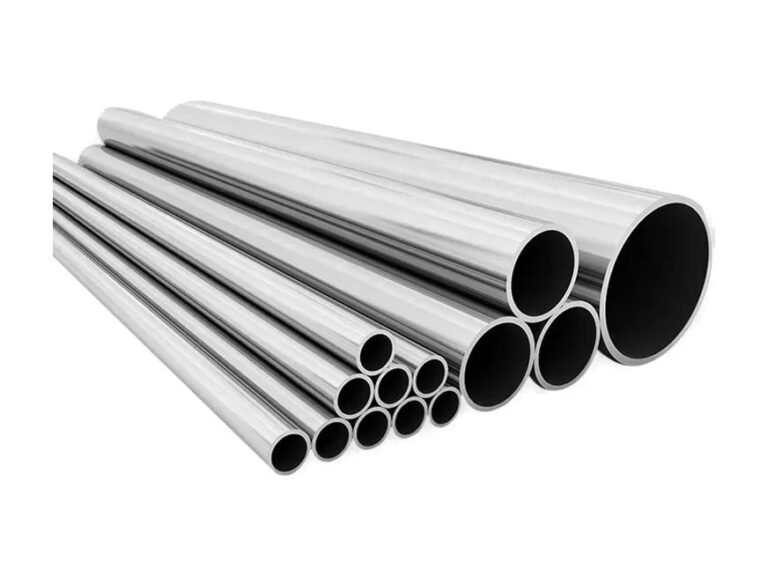
Technical guides on stainless steel pipes, tubes, sheets and tube coils from the Yuhang Metal engineering team.

  • Why Some Buyers Say Stainless Steel from China Doesn’t Meet Standards

    Why Some Buyers Say Stainless Steel from China Doesn’t Meet Standards

    By Yuhang Metal Technical Team · November 2026 · 6 min read

    Quick answer: Many bad experiences with Chinese stainless steel come from deals where the price was too low for the specification, or where nobody checked the supplier. Some suppliers cut wall thickness or switch to cheaper grades to hit a price, and a few are not real suppliers at all. A low price is a warning sign, but a high price is not a guarantee either. What protects you is a supplier who takes responsibility for every production step, and a buyer who verifies before paying.

    Key takeaways

    • Problems often come from orders priced below the real cost of the specification, or from suppliers who were never verified.
    • Common shortcuts: thinner walls, cheaper grades sold as 304, skipped annealing or testing, and certificates that can’t be traced.
    • A 2.0 mm wall supplied on a 2.5 mm nominal-wall order is out of spec under ASTM A312 (minimum about 2.19 mm) and carries about 20% less steel.
    • A low price is a warning sign, but a high price is not a guarantee. Responsibility at every production step is what matters.
    • Quotations depend on grade, processing, testing, quantity, delivery terms and raw material prices.

    Why the complaints happen

    We hear it from buyers in several markets: “The stainless steel we got from China wasn’t what we ordered.” We understand the frustration, and we would rather explain it honestly than pretend it never happens.

    China has thousands of stainless steel suppliers, and their quotes for the same item can differ a lot. When a buyer pushes the price below what the specification really costs, the supplier still has to make money somewhere. Usually it comes out of one of these:

    • Wall thickness: made right at the bottom of the tolerance, or below it.
    • Grade: a cheaper, lower-nickel steel supplied in place of 304.
    • Process steps: annealing, pickling or testing skipped.
    • Paperwork: certificates that can’t be traced to the material actually delivered.

    What “just inside” and “out of spec” look like

    Tolerances in the standards exist for good reasons, but they are also where cost-cutting hides.

    ItemStandard requirementWhat to watch for
    Wall thickness, ASTM A312 pipe (nominal wall ordered)Wall may be up to 12.5% under nominal2.0 mm nominal → minimum 1.75 mm. 2.5 mm nominal → minimum about 2.19 mm. 3.0 mm nominal → minimum about 2.63 mm.
    Grade 304 (ASTM A240)Ni 8.0–10.5%, Cr 17.5–19.5%—
    Grade 201 (ASTM A240)Ni 3.5–5.5%, Cr 16.0–18.0%, Mn 5.5–7.5%Looks the same as 304 but has much lower corrosion resistance
    Low-cost “200-series” gradesNot covered by ASTMSome contain only about 1% Ni and are sometimes sold or marked as 304

    2.5 mm or 2.0 mm? Check the wall yourself

    One of the most common substitutions we see is a 2.0 mm wall delivered against a 2.5 mm order. On the outside the tube looks identical. If the order specifies a 2.5 mm nominal wall and the 12.5% under-tolerance applies, the minimum is about 2.19 mm, so 2.0 mm is out of spec. If the order specifies a 2.5 mm minimum wall, no under-tolerance applies at all.

    For a 60.3 mm OD tube with a uniform wall, the theoretical weight is about 3.60 kg/m at 2.5 mm and about 2.90 kg/m at 2.0 mm, around 19% less steel.

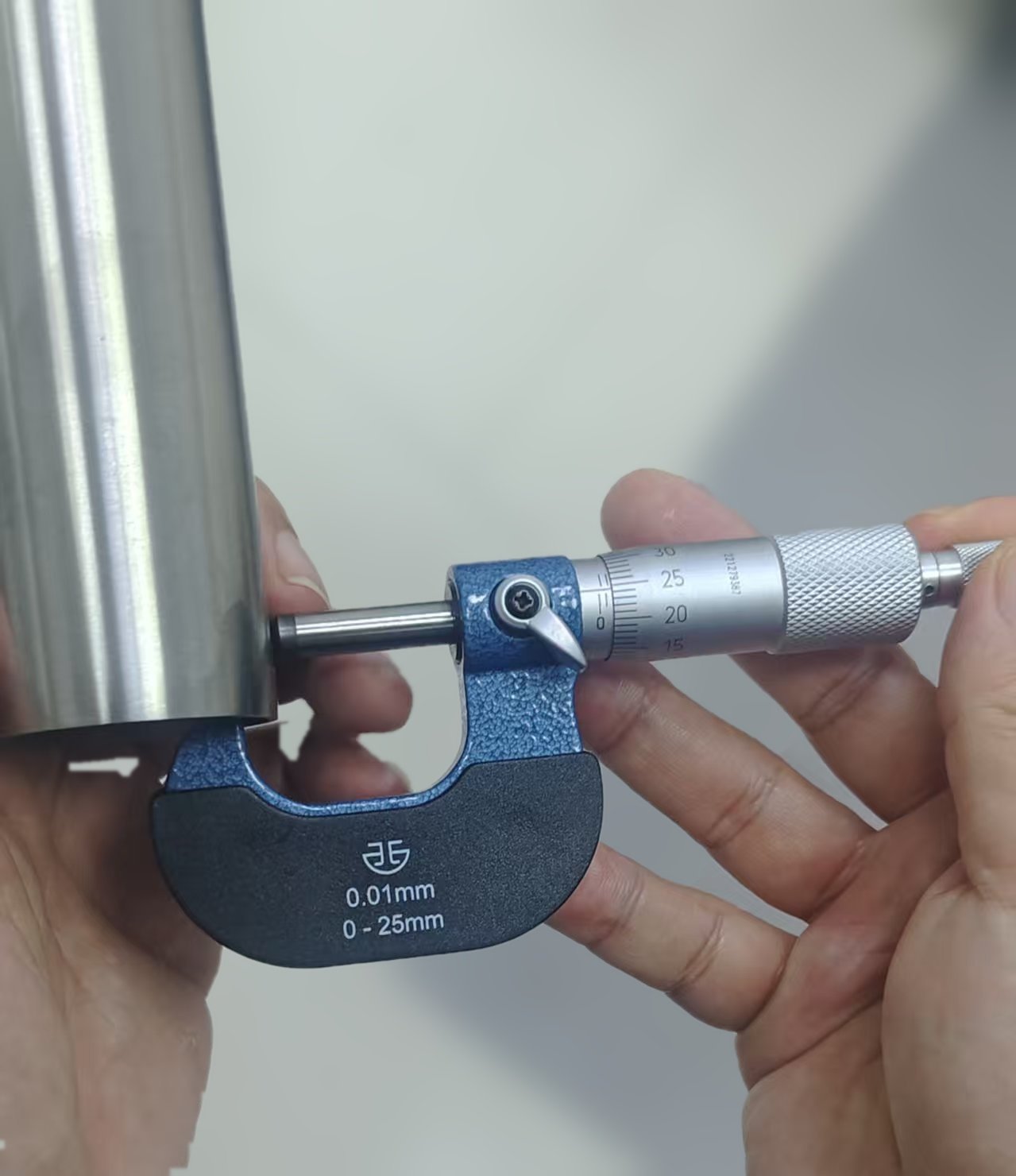
    The check takes a few seconds. Measure the wall at the tube end with a micrometer that reads to 0.01 mm, and take readings at several points around the circumference. This is a sampling check: it does not prove that the whole length, or the whole lot, conforms.
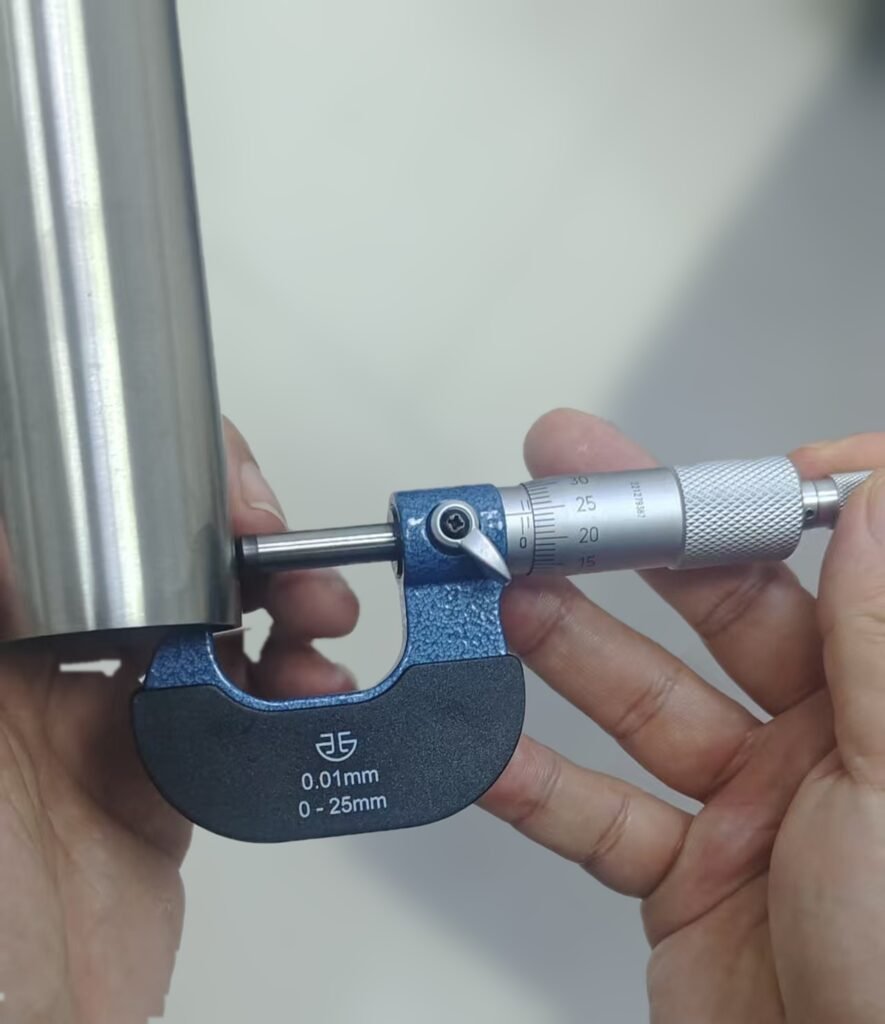
    Micrometer measuring the wall thickness of a stainless steel tube at the tube end
    Wall thickness check on a stainless steel tube with a 0.01 mm micrometer.

    Verify the supplier, not just the price

    Some losses have nothing to do with metallurgy. The material is never shipped, or what arrives is not what was paid for. Basic checks reduce that risk:

    • Verify the business licence and confirm the company actually manufactures or stocks the product.
    • Visit the factory, or ask for a live video tour.
    • Use third-party pre-shipment inspection and loading supervision.
    • Use payment terms that release the balance only against shipping documents or an inspection report.

    Remember that a bill of lading or packing list confirms what was shipped. It is not evidence of quality.

    Low price does not mean good quality, and high price does not guarantee it

    Some suppliers charge more without doing more. The real difference is whether the factory takes responsibility at each stage: raw material selection, forming and welding, heat treatment and pickling, testing, and final inspection before packing. A factory that controls these steps, and can show you the records, can stand behind its product at any price.

    Why responsible Chinese manufacturers protect their name

    More Chinese manufacturers, us included, are building their own brands abroad instead of competing on price alone. An export brand lives on repeat customers and long-term partners. Trading that reputation for one cheap order makes no sense.

    What drives a stainless steel quotation

    Quotations for apparently identical material can differ for legitimate reasons:

    • Grade, for example 304L, 316L or duplex 2205, and whether dual certification is required.
    • Processing: seamless or welded, annealing, pickling, polishing, end finish.
    • Size and wall, and whether the wall is nominal or minimum.
    • Testing and certificates: extra NDE, PMI, intergranular corrosion tests, EN 10204 3.2.
    • Quantity, lengths, packing and delivery terms.
    • Raw material prices: stainless steel costs follow international prices of nickel, chromium and molybdenum, so quotations are normally valid for a limited period.

    When comparing quotations, make sure they are based on the same specification.

    How to make sure you receive what you ordered

    1. Specify the standard and grade in full, for example ASTM A312 TP316L (UNS S31603), with the edition year, and state whether the wall is nominal or minimum.
    2. Ask for EN 10204 3.1 certificates, and check that the grade, size and heat numbers match the marking on the material.
    3. Measure wall thickness and outside diameter on arrival against the tolerances on your order.
    4. Check the grade with PMI. A handheld XRF analyser separates 200-series, 304 and 316, but it cannot measure carbon. If you need to confirm an L grade such as 316L, agree a carbon-capable method such as OES.
    5. If your project needs EN 10204 3.2, agree it before ordering, including who will witness the tests. A general third-party inspection report is not a 3.2 certificate.
    6. Compare quotes on an identical specification. If one is far below the rest, ask exactly what is different.

    Browse our stainless steel pipes and tubes, or request a quote with your grade, size, quantity and inspection requirements.

    Frequently asked questions

    Is stainless steel from China lower quality?

    Not by default. Quality depends on the factory and the specification, not the country.

    Why are some Chinese stainless steel prices so low?

    Often because something changed: a thinner wall, a cheaper grade, or skipped processing or testing. Ask the supplier to quote against an identical, fully written specification.

    What is the minimum wall for 2.5 mm ASTM A312 pipe?

    If 2.5 mm is the nominal wall and the 12.5% under-tolerance applies, the minimum is about 2.19 mm. If 2.5 mm is specified as the minimum wall, the wall must not be below 2.5 mm.

    Can a handheld XRF analyser confirm 316L?

    No. XRF can tell 316 from 304, but it cannot measure carbon, so it cannot confirm the low-carbon L grade on its own.

    Why do stainless steel quotations change?

    They depend on grade, processing, testing, quantity and delivery terms, and on raw material prices such as nickel, chromium and molybdenum.

    References

    • ASTM A312/A312M – Seamless, welded and heavily cold worked austenitic stainless steel pipes
    • ASTM A240/A240M – Stainless steel plate, sheet and strip
    • EN 10204 – Metallic products: types of inspection documents
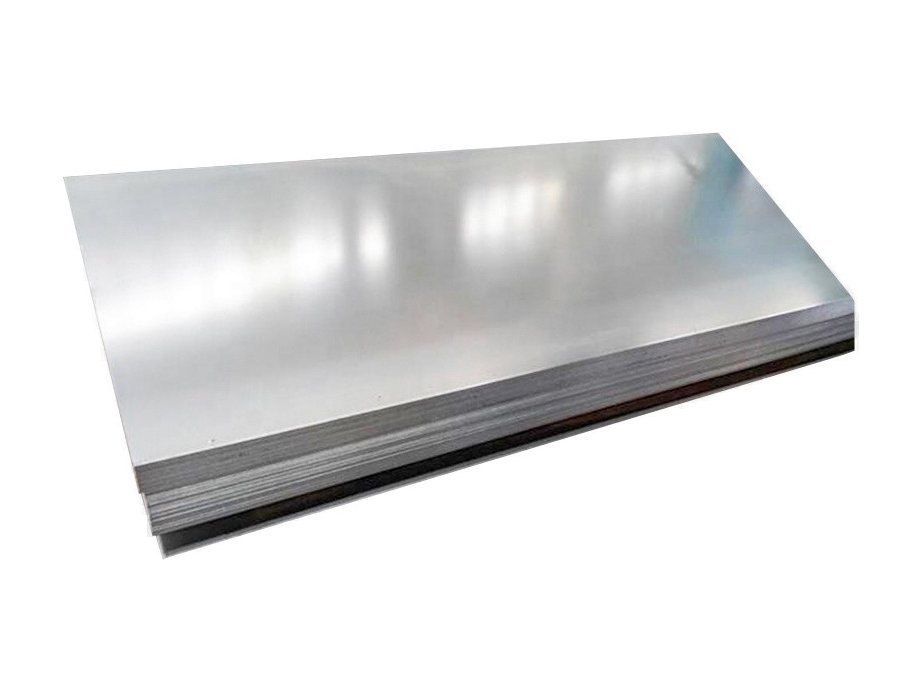
  • Stainless Steel Sheet Thickness, Gauge and Weight Chart (kg/m² and kg per Sheet)

    Stainless Steel Sheet Thickness, Gauge and Weight Chart (kg/m² and kg per Sheet)

    By Yuhang Metal Technical Team · Updated November 2026 · 4 min read

    Short answer: Stainless steel sheet weighs 7.93 kg per m² for every millimetre of thickness (grade 304). A 1.5 mm sheet of 1219 × 2438 mm therefore weighs about 35.4 kg. Grade 316 is about 0.6% heavier. Stainless steel gauges differ from carbon steel gauges, so always confirm the thickness in millimetres.

    Stainless steel sheet and plate are sold by weight, so buyers need to convert between thickness, sheet size and kilograms when they check prices, plan freight or estimate coil lengths. This page gives ready-made weight tables, a stainless gauge conversion and the formulas behind them.

    Key takeaways

    • Weight per square metre = 7.93 × thickness (mm) kg for 304/304L.
    • Weight of one sheet = 7.93 × thickness (mm) × width (m) × length (m).
    • 316/316L is about 0.6% heavier. 430 is about 3% lighter.
    • Stainless steel gauge numbers are not the same as carbon steel or aluminium gauges. Order in millimetres where possible.

    Sheet and plate weight chart

    Theoretical weights for grade 304 at 7.93 g/cm³.

    Thickness (mm)kg/m²1219 × 2438 mm (kg)1250 × 2500 mm (kg)1500 × 3000 mm (kg)
    0.32.387.17.410.7
    0.43.179.49.914.3
    0.53.9611.812.417.8
    0.64.7614.114.921.4
    0.86.3418.919.828.5
    1.07.9323.624.835.7
    1.29.5228.329.742.8
    1.511.8935.437.253.5
    2.015.8647.149.671.4
    2.519.8258.962.089.2
    3.023.7970.774.3107.1
    4.031.7294.399.1142.7
    5.039.65117.8123.9178.4
    6.047.58141.4148.7214.1
    8.063.44188.5198.2285.5
    10.079.30235.7247.8356.8
    12.095.16282.8297.4428.2
    Stainless steel cold-rolled 2b sheets

    Cold-Rolled 2B Sheets
    0.3–6.0 mm, ASTM A240

    Stainless steel brushed & hairline sheets

    Brushed & Hairline Sheets
    No.4, HL, satin, 150#–400#

    Stainless steel mirror sheets

    Mirror Sheets
    6K, 8K and 10K mirror

    Stainless steel pvd colored sheets

    PVD Colored Sheets
    Gold, rose gold, black and more

    Stainless steel gauge to mm

    Gauge numbers for stainless steel sheet (manufacturers’ standard gauge). Carbon steel and aluminium use different values for the same gauge number.

    GaugeInchesmmkg/m² (304)
    100.14063.5728.32
    110.12503.1825.18
    120.10942.7822.04
    140.07811.9815.73
    160.06251.5912.59
    180.05001.2710.07
    200.03750.957.55
    220.03120.796.28
    240.02500.645.04
    260.01870.483.77
    280.01560.403.14

    Formulas for sheet and coil

    • Sheet weight (kg) = 7.93 × t (mm) × W (m) × L (m)
    • Coil weight (kg) = 7.93 × t (mm) × W (m) × coil length (m)
    • Coil length (m) = coil weight (kg) ÷ (7.93 × t × W)

    Example: a 3,000 kg coil of 1.0 mm × 1219 mm grade 304 contains about 3,000 ÷ (7.93 × 1.0 × 1.219) ≈ 310 m of strip.

    Why real weight differs

    • Thickness, width and length tolerances to ASTM A480 or EN 10088-2 mean real sheets are rarely exactly nominal.
    • Protective film, paper interleaving, pallets and wooden cases add to the shipping weight.
    • Agree whether the invoice is based on theoretical weight or actual weighed weight.

    For pipe and tube weights see our pipe weight chart, and for finishes see sheet finishes explained.

    Why source from Yuhang Metal

    • Stainless steel supplier based in Foshan, Guangdong, since 1986. In 1988 we commissioned China’s first stainless steel high-frequency welded pipe mill.
    • Sheet from 0.3 to 6.0 mm cold rolled and hot-rolled plate, in standard sizes or cut to length.
    • Our own grinding, cut-to-length and 1,650 mm precision slitting lines.

    Frequently asked questions

    How do I calculate the weight of a stainless steel sheet?

    Multiply 7.93 by the thickness in mm, the width in m and the length in m. For example, a 1.5 × 1219 × 2438 mm sheet of 304 weighs about 7.93 × 1.5 × 1.219 × 2.438 ≈ 35.4 kg.

    How thick is 16 gauge stainless steel?

    16 gauge stainless steel sheet is 0.0625 inch, or about 1.59 mm, and weighs about 12.6 kg/m² in grade 304.

    Is stainless steel gauge the same as carbon steel gauge?

    No. Gauge numbers are defined separately for stainless steel, carbon steel and aluminium, so the same gauge number can mean a different thickness. Specify thickness in millimetres or inches to avoid errors.

    How long is a stainless steel coil?

    Coil length = coil weight ÷ (7.93 × thickness × width), with thickness in mm and width in m. A 3,000 kg coil of 1.0 × 1219 mm 304 contains about 310 m.

    Is 316 sheet heavier than 304?

    Slightly. 316 has a density of about 7.98 g/cm³ against 7.93 for 304, about 0.6% heavier.

    References

    • ASTM A240/A240M – Stainless steel plate, sheet and strip
    • ASTM A480/A480M – General requirements for flat-rolled stainless steel
    • EN 10088-2 – Stainless steels: sheet, plate and strip
  • Pickling and Passivation of Stainless Steel: What They Do and When You Need Them

    Pickling and Passivation of Stainless Steel: What They Do and When You Need Them

    By Yuhang Metal Technical Team · Updated November 2026 · 4 min read

    Short answer: Pickling removes weld heat tint, scale and the chromium-depleted layer beneath it, usually with nitric–hydrofluoric acid. Passivation removes free iron and other contamination with nitric or citric acid so the chromium oxide film can re-form evenly. Welded parts usually need pickling and passivation. Machined or handled parts without heat tint usually need passivation only.

    Stainless steel resists corrosion because of a thin, chromium-rich oxide film on its surface. Welding, heat treatment, grinding and contact with carbon steel tools can damage that film or contaminate it. Pickling and passivation restore it. They are often mentioned together but do different jobs. This guide explains both and shows when each is needed.

    Key takeaways

    • Pickling removes oxide scale, weld heat tint and the chromium-depleted layer beneath it. It removes a thin layer of metal.
    • Passivation removes free iron and other surface contamination so the passive film forms evenly. It does not remove heat tint or scale.
    • The main references are ASTM A380 (cleaning, descaling and passivation) and ASTM A967 (chemical passivation treatments and tests).
    • Welded coils, tanks and pipe spools normally need pickling followed by passivation.
    • Passivation is verified by tests such as water immersion, humidity, salt spray or copper sulfate, specified on the order.

    Pickling vs passivation

    ItemPicklingPassivation
    PurposeRemove scale, heat tint and the chromium-depleted layerRemove free iron and contamination, promote an even passive film
    Typical chemistryNitric–hydrofluoric acid baths, gels or pastesNitric acid or citric acid solutions
    Metal removalYes, a thin surface layerNegligible
    Removes weld heat tintYesNo
    Typical useAfter welding, hot working or annealing in airAfter machining, forming, handling, or after pickling
    ReferenceASTM A380ASTM A967, ASTM A380

    Why welds need pickling

    Welding heats the metal next to the weld and forms coloured oxide layers, called heat tint, from straw to blue. Beneath that oxide the surface is depleted in chromium, which lowers corrosion resistance. Heat tint is a common starting point for pitting and crevice corrosion, especially in chloride-bearing water. Pickling removes both the oxide and the depleted layer, and passivation then helps the passive film re-form evenly.

    Methods

    • Immersion: the whole part is dipped in a pickling bath. This gives the most uniform result and suits coils, small tanks and pipe spools.
    • Pickling gel or paste: applied locally to welds on large parts, then rinsed off thoroughly.
    • Spray pickling: used for large surfaces and vessel interiors.
    • Electropolishing: an electrochemical process that removes a thin layer, smooths the surface and leaves it passive. It is common for pharmaceutical and food equipment.

    Pickling acids, especially hydrofluoric acid, are hazardous. The work must follow local safety and wastewater rules, and parts must be rinsed with clean, low-chloride water afterwards.

    When is passivation alone enough?

    • Machined, formed or handled parts with no heat tint or scale
    • Parts that may have been contaminated by carbon steel tools, wire brushes or grinding dust
    • Bright annealed tube and sheet that have only been cut or formed
    Stainless steel helical coils

    Helical Coils
    Spiral coils for round, agitated tanks

    Stainless steel sanitary tubes

    Sanitary Tubes
    Polished tubing for hygienic lines

    Stainless steel welded pipes

    Welded Pipes
    ASTM A312 / A358 / A778, NPS 1/8″–30″

    Stainless steel u-bend tubes

    U-Bend Tubes
    A213 / A249 / A688, legs up to 15 m

    How passivation is tested

    ASTM A967 lists test methods that the purchaser selects on the order. They include water immersion, high humidity, salt spray, copper sulfate, and potassium ferricyanide–nitric acid tests. These look for free iron or rust on the treated surface. Many hygienic and pharmaceutical projects also specify surface roughness and cleanliness checks.

    How to specify it on an order

    1. State the treatment: pickled and passivated, passivated only, or electropolished
    2. Name the standard and method, for example ASTM A967 Nitric 2 or Citric 1
    3. Specify the verification test, for example water immersion or copper sulfate
    4. Specify the rinse water quality and packing that protects the surface from contamination

    Related reading: how to choose a stainless steel tube coil and stainless steel sheet finishes.

    Why source from Yuhang Metal

    • Stainless steel supplier based in Foshan, Guangdong, since 1986. In 1988 we commissioned China’s first stainless steel high-frequency welded pipe mill.
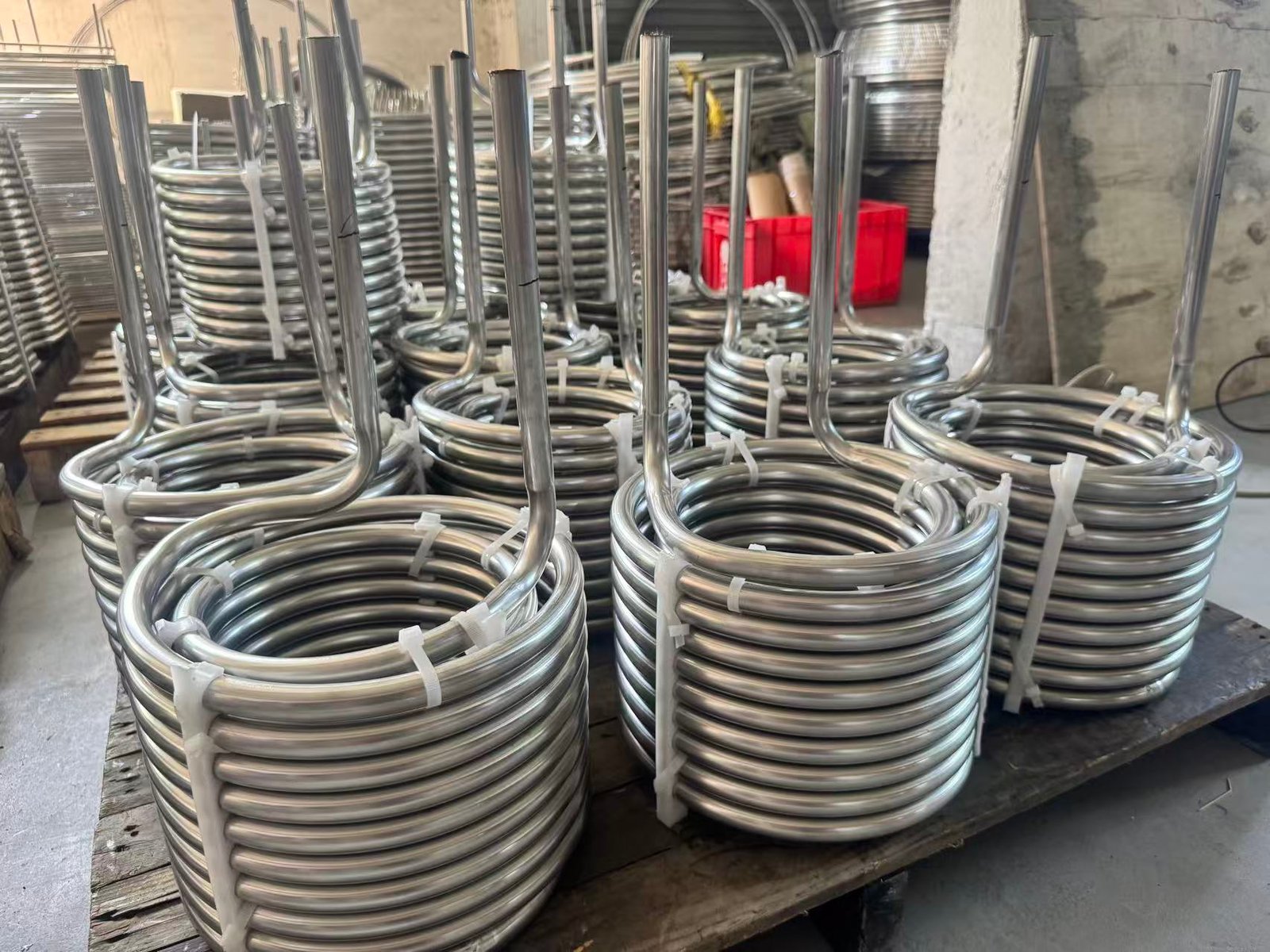
    • Tube coils supplied pickled and passivated as standard, with bright annealed or electropolished options.
    • Welded pipe supplied pickled and annealed, bright annealed or polished.

    Frequently asked questions

    What is the difference between pickling and passivation?

    Pickling removes scale, weld heat tint and the chromium-depleted layer by dissolving a thin layer of metal. Passivation removes free iron and contamination so the chromium oxide film forms evenly. It does not remove heat tint.

    Does stainless steel need passivation after welding?

    Welds usually need pickling first to remove heat tint, followed by passivation. Passivation alone does not remove heat tint.

    Is citric acid passivation as good as nitric acid?

    ASTM A967 includes both nitric and citric acid treatments. Citric acid is safer to handle and widely used. The choice and the verification test should be specified on the order.

    How do I know if a part has been passivated properly?

    Specify a test from ASTM A967, such as water immersion, high humidity, salt spray or copper sulfate. These detect free iron on the surface.

    Are Yuhang tube coils pickled and passivated?

    Yes. Our tube coils are supplied pickled and passivated as standard, with bright annealed or electropolished options.

    References

    • ASTM A380/A380M – Cleaning, descaling and passivation of stainless steel parts, equipment and systems
    • ASTM A967/A967M – Chemical passivation treatments for stainless steel parts
    • ASTM B912 – Passivation of stainless steels using electropolishing
  • Duplex 2205 vs 316L Stainless Steel: Strength, Corrosion Resistance and When to Upgrade

    Duplex 2205 vs 316L Stainless Steel: Strength, Corrosion Resistance and When to Upgrade

    By Yuhang Metal Technical Team · Updated November 2026 · 5 min read

    Short answer: Duplex 2205 has roughly twice the yield strength of 316L and much better resistance to chloride pitting and chloride stress corrosion cracking (PREN about 35 against about 24). Choose 2205 for seawater, brines, warm chloride-bearing water and where thinner walls save weight. Stay with 316L for cryogenic or above about 300 °C service, and where easy forming and welding matter most.

    316L is the default “upgrade” stainless steel for corrosive service. But in seawater, brines and warm chloride-bearing water, 316L can still pit or crack. Duplex 2205 is usually the next step. This guide compares the two grades and shows when the upgrade is worth it.

    Key takeaways

    • 2205 is a duplex grade with a roughly 50/50 mix of ferrite and austenite. 316L is fully austenitic.
    • 2205 has a minimum yield strength of 450 MPa against 170 MPa for 316L (ASTM A240), so walls can often be thinner.
    • 2205 resists chloride pitting and stress corrosion cracking much better than 316L (PREN about 35 against about 24).
    • 2205 is magnetic, is generally limited to about 300 °C, and needs controlled welding procedures.
    • 316L remains the better choice for cryogenic service and for parts that need heavy forming.

    Chemical composition

    Grade (UNS)C maxCrNiMoN
    316L (S31603)0.03016.0–18.010.0–14.02.00–3.000.10 max
    2205 (S32205)0.03022.0–23.04.5–6.53.0–3.50.14–0.20
    2205 (S31803)0.03021.0–23.04.5–6.52.5–3.50.08–0.20

    S32205 is the tighter, higher-nitrogen version of the original S31803. Material is often dual-certified to both.

    Mechanical properties

    GradeTensile strength, min (MPa)Yield strength, min (MPa)Elongation, min (%)
    316L48517040
    2205 (S32205)65545025

    Values are ASTM A240 minimums for annealed plate, sheet and strip. The higher strength of 2205 allows thinner walls for the same pressure, which can offset its price per kilogram.

    Corrosion resistance

    • Pitting and crevice corrosion: PREN = %Cr + 3.3 × %Mo + 16 × %N gives about 35 for 2205 and about 24 for 316L. 2205 tolerates higher chloride levels and temperatures before pitting starts.
    • Chloride stress corrosion cracking: austenitic grades such as 316L can crack under tensile stress in warm chloride solutions. The duplex structure of 2205 gives much greater resistance.
    • Seawater: 316L is generally not recommended for long-term seawater immersion. 2205 performs better, and super duplex 2507 is used for more demanding seawater service.

    Temperature limits

    Long exposure to roughly 300–500 °C can embrittle the ferrite in duplex steels, so 2205 is generally limited to about 300 °C in service. At low temperatures, 2205 loses toughness well before 316L does. For cryogenic service, austenitic grades such as 316L are the usual choice.

    Stainless steel seamless pipes

    Seamless Pipes
    ASTM A312 / A213 / A269 / A790

    Stainless steel welded pipes

    Welded Pipes
    ASTM A312 / A358 / A778, NPS 1/8″–30″

    Stainless steel u-bend tubes

    U-Bend Tubes
    A213 / A249 / A688, legs up to 15 m

    Stainless steel helical coils

    Helical Coils
    Spiral coils for round, agitated tanks

    Welding and fabrication

    • 2205 needs qualified procedures with controlled heat input and interpass temperature, and a matching over-alloyed filler (such as 2209), to keep the ferrite–austenite balance.
    • Ferrite content and, for critical service, testing for harmful intermetallic phases (ASTM A923) are often specified.
    • 2205 is stronger and springs back more, so bending and forming need more force. 316L is easier to form, roll into coils and weld.

    Cost

    2205 contains less nickel but more chromium, molybdenum and nitrogen than 316L. Depending on alloy prices, it can be cost-competitive per metre, especially when its higher strength allows a thinner wall. Compare complete quotations for the actual design rather than price per kilogram alone.

    Which to choose

    ApplicationUsual choice
    Food, pharmaceutical and general process lines316L
    Seawater, desalination and offshore lines2205, or 2507 for harsher duty
    Warm chloride-bearing cooling water and heat exchanger tubes2205
    Chemical tanks and brine heating coils2205 where chlorides cause pitting or cracking in 316L
    Cryogenic service316L or 304L
    Service above about 300 °CAustenitic grades such as 316L, 321 or 310S

    Standards for duplex products

    • Pipe: ASTM A790. Tube: ASTM A789. Plate, sheet and strip: ASTM A240.
    • Forged flanges and fittings: ASTM A182 (F51 / F60). Wrought fittings: ASTM A815.
    • Detection of intermetallic phases: ASTM A923.

    See also our 304 vs 316 guide and duplex pipes.

    Why source from Yuhang Metal

    • Stainless steel supplier based in Foshan, Guangdong, since 1986. In 1988 we commissioned China’s first stainless steel high-frequency welded pipe mill.
    • Duplex pipe and tube to ASTM A790 and A789 in 2205 and 2507, plus 2205 sheet, U-bend tubes and tube coils.
    • EN 10204 3.1 certificates, with PMI and other tests available on request.

    Frequently asked questions

    Is duplex 2205 better than 316L?

    For chloride environments, yes: 2205 has much better resistance to pitting and chloride stress corrosion cracking and about twice the yield strength. 316L is still better for cryogenic service, service above about 300 °C, and parts that need heavy forming.

    Is duplex 2205 magnetic?

    Yes. About half of its structure is ferrite, so 2205 is magnetic. 316L is essentially non-magnetic when annealed.

    Can I replace 316L with 2205 using the same wall thickness?

    You can, but you would not use its full strength. Because 2205 has a much higher allowable stress, a thinner wall often meets the same pressure rating. The design should be checked against the applicable code.

    What is the difference between S31803 and S32205?

    Both are 2205 duplex. S32205 has tighter limits with higher minimum chromium, molybdenum and nitrogen, giving more consistent corrosion resistance. Material is often dual-certified S31803/S32205.

    Which standard covers duplex stainless steel pipe?

    ASTM A790/A790M covers seamless and welded duplex pipe, and ASTM A789/A789M covers duplex tubing.

    References

    • ASTM A240/A240M – Stainless steel plate, sheet and strip
    • ASTM A790/A790M and A789/A789M – Duplex stainless steel pipe and tubing
    • ASTM A923 – Detecting detrimental intermetallic phase in duplex stainless steels
    • ASTM A182/A182M and A815/A815M – Flanges and fittings
  • EN 10204 3.1 vs 3.2 Mill Test Certificates: What They Mean and How to Check Them

    EN 10204 3.1 vs 3.2 Mill Test Certificates: What They Mean and How to Check Them

    By Yuhang Metal Technical Team · Updated November 2026 · 6 min read

    Short answer: An EN 10204 3.1 certificate reports test results for the actual material delivered and is validated by the manufacturer’s inspection representative, who is independent of production. A 3.2 certificate carries the same results but is also validated by the purchaser’s representative or a third-party inspector, which adds cost and time. Either way, the certificate is only meaningful if its heat number matches the marking on the material.

    Almost every order for stainless steel pipe, tube or sheet asks for “EN 10204 3.1” certificates, and some projects require “3.2”. Buyers often call these mill test certificates (MTC) or mill test reports (MTR). This guide explains what each EN 10204 document type means, what a good stainless steel certificate contains, and how to check one before you accept the material.

    Key takeaways

    • EN 10204 defines four types of inspection document: 2.1, 2.2, 3.1 and 3.2.
    • Type 3.1 reports results of specific inspection on the delivered product and is validated by the manufacturer’s authorised inspection representative, who is independent of the manufacturing department.
    • Type 3.2 is also validated by the purchaser’s authorised representative, or by an inspector designated by official regulations. It must be arranged before production and testing.
    • Always match the heat number on the certificate to the marking on the material.
    • Check every value against the specification limits, and verify critical elements with PMI on arrival.

    The four EN 10204 document types

    TypeDocumentContentValidated by
    2.1Declaration of compliance with the orderStatement that the products comply with the order. No test resultsThe manufacturer
    2.2Test reportStatement of compliance, with results of non-specific inspectionThe manufacturer
    3.1Inspection certificate 3.1Statement of compliance, with results of specific inspectionThe manufacturer’s authorised inspection representative, independent of the manufacturing department
    3.2Inspection certificate 3.2Statement of compliance, with results of specific inspectionThe manufacturer’s authorised inspection representative and the purchaser’s authorised inspection representative or the inspector designated by official regulations

    Non-specific inspection is carried out on products of the same kind that are not necessarily from the delivery. Specific inspection is carried out on the products to be supplied, or on test units of which they form part. This is why 3.1 and 3.2 certificates are the norm for pressure and process applications.

    What a stainless steel mill test certificate should contain

    • Header: manufacturer’s name, certificate number and date, the EN 10204 type, customer and order number
    • Product: description, product standard and edition (for example ASTM A312/A312M-24), grade and UNS number, dimensions and quantity
    • Traceability: heat number and, where relevant, lot or bundle numbers
    • Chemical analysis: heat or product analysis for every element specified
    • Mechanical tests: tensile strength, yield strength, elongation and hardness
    • Other tests: hydrostatic or eddy current, flattening and flaring, intergranular corrosion (with the ASTM A262 practice), grain size and others as ordered
    • Condition: heat treatment (for example solution annealed), surface finish and marking
    • Statement of compliance, with the signature and stamp of the inspection representative, plus the third-party inspector’s stamp on a 3.2 certificate

    How to check a certificate, step by step

    1. Match the heat numbers. Every heat number on the labels or stencil marking should appear on a certificate, and every certificate should relate to material in the shipment.
    2. Check the specification and grade against your order, including the edition. For dual-certified material, both grades should be stated, for example 316/316L.
    3. Compare the chemistry with the specification limits. For example, 316L must show C ≤ 0.030% and Mo 2.00–3.00% under ASTM A240.
    4. Check the mechanical results against the minimum values for the grade and condition.
    5. Confirm that every test you ordered is reported, such as the hydrostatic test pressure, eddy current, or ASTM A262 Practice E.
    6. Check sizes and quantities against the packing list.
    7. Verify on arrival with PMI. A handheld XRF analyser confirms Cr, Ni and Mo (for example, 304 against 316) but cannot measure carbon. Use optical emission spectrometry (OES) to confirm L-grade carbon.

    Warning signs

    • Heat numbers on the material that do not appear on any certificate
    • Identical chemistry and test results reported for different heats
    • Values sitting exactly on a specification limit across many elements
    • Signs of editing on scanned certificates, or certificates with no manufacturer reference
    • Tests you ordered missing from the certificate
    Stainless steel seamless pipes

    Seamless Pipes
    ASTM A312 / A213 / A269 / A790

    Stainless steel welded pipes

    Welded Pipes
    ASTM A312 / A358 / A778, NPS 1/8″–30″

    Stainless steel cold-rolled 2b sheets

    Cold-Rolled 2B Sheets
    0.3–6.0 mm, ASTM A240

    Stainless steel u-bend tubes

    U-Bend Tubes
    A213 / A249 / A688, legs up to 15 m

    When do you need a 3.2 certificate?

    A 3.2 certificate is needed when the contract, the project specification or a regulatory or classification body requires independent verification of the tests. This is common in oil and gas, power generation and some pressure equipment and marine projects. The purchaser or the regulation names the inspection body, and the inspector must witness the specified tests. Agree this at the enquiry stage, because it adds cost and affects the production schedule. For most industrial orders, a 3.1 certificate is sufficient.

    Traceability after cutting and fabrication

    When pipe is cut, tube is bent into coils or U-tubes, or sheet is cut to size, the original certificate still applies only if the heat number can be traced to each finished part. Ask your supplier how heat numbers are transferred through processing and recorded in the fabrication documents. EN 10204 also expects intermediaries such as stockists to pass on the manufacturer’s inspection documents without alteration.

    Why source from Yuhang Metal

    • Stainless steel supplier based in Foshan, Guangdong, since 1986. In 1988 we commissioned China’s first stainless steel high-frequency welded pipe mill.
    • EN 10204 3.1 certificates with our pipes, tubes and tube coils, showing heat numbers, chemistry, mechanical properties and test results.
    • Third-party inspection for EN 10204 3.2 certificates and PMI testing can be arranged on request.

    Frequently asked questions

    What is the difference between EN 10204 3.1 and 3.2?

    Both report results of specific inspection on the delivered material. A 3.1 certificate is validated by the manufacturer’s authorised inspection representative, who is independent of production. A 3.2 certificate is also validated by the purchaser’s authorised representative or an inspector designated by official regulations, usually a third-party inspection body.

    Is a mill test certificate the same as an EN 10204 3.1 certificate?

    “Mill test certificate” (MTC) and “mill test report” (MTR) are general terms. An EN 10204 3.1 inspection certificate is one specific type. State the required EN 10204 type on your order rather than only asking for an MTC.

    Can a trader or stockist issue a 3.1 certificate?

    The 3.1 certificate is issued by the manufacturer. EN 10204 expects intermediaries to pass on the manufacturer’s documents without alteration, with a way to identify the product. If material has been processed, ask how traceability to the original certificate is kept.

    Can a PMI test replace a mill certificate?

    No. PMI confirms the alloy type on arrival, but it does not replace the certified chemical analysis, mechanical tests and other results on the certificate. Handheld XRF also cannot measure carbon.

    Does Yuhang Metal supply EN 10204 3.1 and 3.2 certificates?

    Yes. EN 10204 3.1 certificates are supplied with our pipes, tubes and tube coils. Third-party inspection for 3.2 certificates can be arranged on request at the enquiry stage.

    References

    • EN 10204:2004 – Metallic products: types of inspection documents
    • ASTM A240/A240M and ASTM A312/A312M
    • ASTM A262 – Intergranular attack in austenitic stainless steels
    • ASTM E1476 – Metals identification, grade verification and sorting
  • Stainless Steel Pipe Weight Chart (kg/m) and Weight Formulas for Pipe, Tube and Sheet

    Stainless Steel Pipe Weight Chart (kg/m) and Weight Formulas for Pipe, Tube and Sheet

    By Yuhang Metal Technical Team · Updated November 2026 · 6 min read

    Short answer: The weight of round stainless steel pipe is W = 0.02491 × (OD − t) × t, in kg/m with OD and wall t in mm, based on a density of 7.93 g/cm³ for 304. For example, 2″ Schedule 40S pipe (60.3 × 3.91 mm) weighs 5.49 kg/m. Grade 316 is about 0.6% heavier.

    Stainless steel pipe is usually priced and shipped by weight, so knowing the weight per metre helps you check quotations, plan container loads and calculate structural loads. This page gives a weight chart for common pipe sizes and schedules, the formulas used to calculate it, and formulas for other shapes such as square tube, rectangular tube and sheet.

    Key takeaways

    • Round pipe weight: W (kg/m) = 0.02491 × (OD − t) × t, with OD and wall thickness t in mm, for 304 at 7.93 g/cm³.
    • Pipe dimensions for stainless schedules 5S, 10S, 40S and 80S follow ASME B36.19M.
    • Grade 316/316L is about 0.6% heavier than 304. Duplex 2205 and ferritic 430 are slightly lighter.
    • Chart weights are theoretical. Real weights vary with wall and diameter tolerances, so agree whether you are invoiced by theoretical or actual weight.

    Stainless steel pipe weight formula

    The cross-sectional area of a pipe wall is π × (OD − t) × t. Multiplying by the density gives the weight per unit length:

    W = π × ρ × (OD − t) × t / 1000. With ρ = 7.93 g/cm³ for 304/304L, this becomes W = 0.02491 × (OD − t) × t kg/m.

    Worked example: 2″ Schedule 40S pipe has an OD of 60.3 mm and a wall of 3.91 mm.

    • W = 0.02491 × (60.3 − 3.91) × 3.91 = 5.49 kg/m
    • A 6 m length weighs about 6 × 5.49 ≈ 33.0 kg

    Stainless steel pipe weight chart (kg/m)

    Each cell shows wall thickness (mm) / weight (kg/m). Dimensions follow ASME B36.19M. Weights are calculated for 304/304L at 7.93 g/cm³. For 316/316L, multiply by 1.006.

    NPSOD (mm)Sch 5SSch 10SSch 40SSch 80S
    1/8″10.3—1.24 / 0.281.73 / 0.372.41 / 0.47
    1/4″13.7—1.65 / 0.502.24 / 0.643.02 / 0.80
    3/8″17.1—1.65 / 0.642.31 / 0.853.20 / 1.11
    1/2″21.31.65 / 0.812.11 / 1.012.77 / 1.283.73 / 1.63
    3/4″26.71.65 / 1.032.11 / 1.292.87 / 1.703.91 / 2.22
    1″33.41.65 / 1.312.77 / 2.113.38 / 2.534.55 / 3.27
    1-1/4″42.21.65 / 1.672.77 / 2.723.56 / 3.434.85 / 4.51
    1-1/2″48.31.65 / 1.922.77 / 3.143.68 / 4.095.08 / 5.47
    2″60.31.65 / 2.412.77 / 3.973.91 / 5.495.54 / 7.56
    2-1/2″73.02.11 / 3.733.05 / 5.325.16 / 8.727.01 / 11.52
    3″88.92.11 / 4.563.05 / 6.525.49 / 11.417.62 / 15.43
    4″114.32.11 / 5.903.05 / 8.456.02 / 16.248.56 / 22.55
    5″141.32.77 / 9.563.40 / 11.686.55 / 21.999.53 / 31.28
    6″168.32.77 / 11.423.40 / 13.977.11 / 28.5510.97 / 43.00
    8″219.12.77 / 14.933.76 / 20.178.18 / 42.9812.70 / 65.30
    10″273.13.40 / 22.844.19 / 28.079.27 / 60.9312.70 / 82.39
    12″323.93.96 / 31.564.57 / 36.369.53 / 74.6412.70 / 98.46

    Need the wall thicknesses only? See the schedule chart on our stainless steel pipes and tubes page.

    Stainless steel welded pipes

    Welded Pipes
    ASTM A312 / A358 / A778, NPS 1/8″–30″

    Stainless steel seamless pipes

    Seamless Pipes
    ASTM A312 / A213 / A269 / A790

    Stainless steel round tubes

    Round Tubes
    Welded and seamless round tube

    Weight formulas for other shapes

    ProductFormula (304, 7.93 g/cm³)Example
    Round pipe or tubeW = 0.02491 × (OD − t) × t (kg/m)25.4 × 1.5 mm tube: 0.89 kg/m
    Square tube (a × a × t)W ≈ 0.03172 × t × (a − t) (kg/m)50 × 50 × 2 mm: 3.05 kg/m
    Rectangular tube (a × b × t)W ≈ 0.01586 × t × (a + b − 2t) (kg/m)60 × 40 × 2 mm: 3.05 kg/m
    Sheet or plateW = 7.93 × t (kg/m²)1.5 mm sheet, 1219 × 2438 mm: 35.4 kg per sheet
    Tube coilTube weight per metre × developed tube length50.3 m of 25.4 × 1.5 mm tube: about 45 kg

    The square and rectangular formulas treat the corners as sharp. Real tube has rounded corners, so its actual weight is slightly lower. For coil tube length, see our guide on how to choose a stainless steel tube coil.

    Density of common stainless steel grades

    GradeApproximate density (g/cm³)Factor vs 304
    304 / 304L7.931.000
    316 / 316L7.981.006
    2205 duplex7.8about 0.98
    430 ferritic7.7about 0.97

    Why actual weight differs from the chart

    • Wall tolerance. Pipe specifications such as ASTM A312 allow the wall to be up to 12.5% under nominal at any point, and mills often run close to nominal or slightly under.
    • OD tolerance and the weld bead also change the real cross-section.
    • Packing. Wooden cases, bundles, end caps and protective film add to the shipping weight but not to the steel weight.

    When you compare quotations, check whether the price is per theoretical weight, per actual (weighed) weight, or per metre.

    How to use the chart when ordering

    1. Confirm NPS and schedule, or OD × wall for tube, against the project specification.
    2. Calculate the total weight from the required length to estimate freight and handling.
    3. Agree the basis of invoicing: theoretical weight, actual weight, or per metre.
    4. Specify grade, standard, length, end finish and certificates on the order.

    Why source from Yuhang Metal

    • Stainless steel supplier based in Foshan, Guangdong, since 1986. In 1988 we commissioned China’s first stainless steel high-frequency welded pipe mill.
    • Welded pipe from NPS 1/8″ to 30″ and seamless pipe from 6 to 273 mm OD, in schedules from 5S to XXS.
    • Pipes, tubes, sheets and plates supplied with EN 10204 3.1 certificates and packed for export.

    Frequently asked questions

    How do you calculate the weight of stainless steel pipe?

    Use W = 0.02491 × (OD − t) × t, where W is in kg/m and the outside diameter OD and wall thickness t are in mm. The constant comes from π × 7.93 g/cm³ / 1000 for grade 304.

    How much does a 6 m length of 2-inch Schedule 40S stainless pipe weigh?

    2″ Schedule 40S pipe is 60.3 mm OD × 3.91 mm wall and weighs about 5.49 kg/m in grade 304, so a 6 m length weighs about 33 kg.

    Is 316 stainless steel heavier than 304?

    Slightly. 316/316L has a density of about 7.98 g/cm³ against 7.93 g/cm³ for 304/304L, so 316 pipe is about 0.6% heavier for the same size.

    What is the difference between Schedule 40 and Schedule 40S?

    The S schedules are defined for stainless steel in ASME B36.19M. Up to NPS 10, Schedule 40S has the same wall as Schedule 40 in ASME B36.10M, but from NPS 12 they differ. Schedule 80S matches Schedule 80 up to NPS 8 and is thinner from NPS 10.

    Why is my invoiced weight different from the chart?

    Chart weights are theoretical. Actual pipe varies with wall and diameter tolerances, so weighed pipe is often slightly lighter or heavier. Agree before ordering whether you will be invoiced by theoretical weight, actual weight or length.

    References

    • ASME B36.19M – Stainless steel pipe
    • ASME B36.10M – Welded and seamless wrought steel pipe
    • ASTM A312/A312M – Seamless, welded and heavily cold worked austenitic stainless steel pipes
  • Seamless vs Welded Stainless Steel Pipe: Differences, Pressure Ratings and How to Choose

    Seamless vs Welded Stainless Steel Pipe: Differences, Pressure Ratings and How to Choose

    By Yuhang Metal Technical Team · Updated November 2026 · 6 min read

    Short answer: Seamless pipe has no weld seam and is preferred for high pressure, high temperature, heavy walls and cyclic service. Welded stainless pipe, solution annealed and tested to ASTM A312, suits most water, food and general process duties, with a more uniform wall, smoother bore, lower cost and shorter lead time. Check first whether your project specification makes seamless mandatory.

    “Seamless or welded?” is one of the first decisions when buying stainless steel pipe. Both are covered by the same main specification, ASTM A312, and both can be made in the same grades. They differ in how they are made, and that affects pressure design, dimensional tolerances, surface, size range, cost and lead time. This guide explains the differences and when each is the right choice.

    Key takeaways

    • Seamless pipe is made from a pierced solid billet and has no weld seam. Welded pipe is formed from strip or plate and welded along its length.
    • Under ASME B31.3, seamless pipe has a longitudinal weld joint quality factor of 1.0. Welded pipe has a factor between 0.80 and 1.0, depending on the weld type and the extent of radiography.
    • Welded pipe usually has a more uniform wall and a smoother bore, costs less and is available faster, in larger diameters.
    • Seamless pipe covers heavier walls and is preferred for high-pressure, high-temperature and cyclic service.
    • Properly annealed and pickled welded pipe performs well in most corrosive media. For severe service, specify annealing and intergranular corrosion testing.

    How seamless stainless steel pipe is made

    1. A solid round billet is heated and pierced, by rotary piercing or hot extrusion, to form a hollow shell.
    2. The hollow is reduced to the final size by cold drawing or cold pilgering, often in several passes with intermediate annealing.
    3. The pipe is solution annealed, pickled, straightened, cut to length and tested.

    How welded stainless steel pipe is made

    1. Cold-rolled stainless strip is slit to width and roll-formed into a tube.
    2. The seam is fusion welded, usually by TIG, plasma or laser without filler metal. Large diameters are formed from plate and welded with filler (electric fusion welded, EFW).
    3. The weld bead is worked and the pipe is solution annealed, either in-line or in a furnace, then sized, straightened, pickled or bright annealed, and tested.

    Seamless vs welded: side-by-side comparison

    FactorSeamless pipeWelded pipe
    Weld seamNoneLongitudinal weld, annealed
    Pressure design (ASME B31.3 joint factor)1.00.80–1.0, depending on weld type and radiography
    Wall uniformitySome wall variation (eccentricity) from piercingVery uniform, from rolled strip
    Bore surfaceDepends on drawing and finishingSmooth, from cold-rolled strip
    Heavy walls and small boresWell suitedLimited by strip thickness and forming
    Large diametersLimited and costlyReadily available, including EFW from plate
    Cost and lead timeHigher, longerLower, shorter
    Typical standardsASTM A312, A213, A269, A790ASTM A312, A358, A778, A249, A269
    Our size rangeOD 6–273 mm, wall 0.5–25 mm, Sch 5S–XXSNPS 1/8″–30″ (OD 10.3–762 mm), wall 0.5–20 mm

    Is welded pipe as corrosion resistant as seamless?

    For most environments, yes, provided the pipe is solution annealed after welding and properly pickled or bright annealed. Annealing dissolves carbides and homogenises the weld structure, so the weld zone behaves close to the parent metal. Unannealed welded pipe, such as ASTM A778, is intended only for low- and moderate-temperature corrosive service where annealing is not needed. For severe media, specify annealed pipe in an L grade and intergranular corrosion testing to ASTM A262 Practice E. Compare grades in our 304 vs 316 guide.

    Stainless steel seamless pipes

    Seamless Pipes
    ASTM A312 / A213 / A269 / A790

    Stainless steel welded pipes

    Welded Pipes
    ASTM A312 / A358 / A778, NPS 1/8″–30″

    Stainless steel sanitary tubes

    Sanitary Tubes
    Polished tubing for hygienic lines

    Stainless steel round tubes

    Round Tubes
    Welded and seamless round tube

    When to choose seamless pipe

    • High-pressure or high-temperature lines where the full allowable stress is needed without radiography
    • Heavy walls (Sch 80S, 160 and XXS) and small-bore, thick-wall instrumentation lines
    • Cyclic or fatigue loading, and hydraulic systems
    • Projects whose piping specification requires seamless pipe, as many oil and gas and power specifications do

    When to choose welded pipe

    • Water, food and beverage, pharmaceutical and general process piping
    • Large diameters, and thin walls such as Sch 5S and 10S
    • Applications that need a smooth, uniform bore or tight wall tolerance
    • Cost-sensitive projects and short delivery times

    Testing and inspection

    • Both: ASTM A312 requires each length to be hydrostatically tested or examined by a non-destructive electric test such as eddy current, plus flattening and other mechanical tests.
    • Welded pipe: radiography (X-ray) of the weld can be specified. Under ASTM A358, the pipe class defines the extent of radiography.
    • Seamless pipe: ultrasonic examination is often specified for heavy walls and critical service.
    • Either: PMI, intergranular corrosion testing and third-party inspection can be added on the order.

    How to specify on your order

    1. Standard and grade, for example ASTM A312 TP316L, and seamless or welded
    2. NPS and schedule, or OD × wall
    3. Length, end finish (plain, beveled, threaded) and surface (pickled, bright annealed, polished)
    4. Extra tests: radiography, ultrasonic, PMI, ASTM A262 Practice E
    5. Certificates: EN 10204 3.1 or 3.2

    Compare the ASTM specifications in detail in our pipe and tube standards guide, and check weights in the pipe weight chart.

    Why source from Yuhang Metal

    • Stainless steel supplier based in Foshan, Guangdong, since 1986. In 1988 we commissioned China’s first stainless steel high-frequency welded pipe mill.
    • Welded pipe from NPS 1/8″ to 30″ (TIG, plasma, laser or EFW, with the weld bead annealed) and seamless pipe from 6 to 273 mm OD.
    • Hydrostatic and eddy current testing, with weld X-ray, ultrasonic, PMI and intergranular corrosion testing available.
    • EN 10204 3.1 or 3.2 certificates.

    Frequently asked questions

    Is seamless pipe stronger than welded pipe?

    The material strength is the same for the same grade and condition. The difference is in pressure design: piping codes such as ASME B31.3 give seamless pipe a weld joint factor of 1.0, while welded pipe may be derated unless the weld is fully radiographed.

    Can welded stainless steel pipe be used for high pressure?

    Yes, within the limits of the design code, after applying the appropriate weld joint factor or specifying full radiography. Many process systems use welded ASTM A312 pipe. Some project specifications, however, require seamless pipe above certain pressures or sizes.

    Why is welded pipe cheaper than seamless?

    Welded pipe is formed continuously from cold-rolled strip, with high material yield and fast production. Seamless pipe needs billet piercing and several cold-working and annealing passes, which add cost and time.

    Does ASTM A312 cover both seamless and welded pipe?

    Yes. ASTM A312 covers seamless, welded and heavily cold worked austenitic stainless steel pipe. The order must state which type is required.

    What sizes of seamless and welded pipe can Yuhang Metal supply?

    Welded pipe from NPS 1/8″ to 30″ (OD 10.3–762 mm) with walls of 0.5–20 mm, and seamless pipe from 6 to 273 mm OD with walls of 0.5–25 mm, from Sch 5S to XXS. Larger sizes are available on request.

    References

    • ASTM A312/A312M – Seamless, welded and heavily cold worked austenitic stainless steel pipes
    • ASTM A358/A358M and ASTM A778/A778M
    • ASTM A262 – Intergranular attack in austenitic stainless steels
    • ASME B31.3 – Process Piping
  • 304 vs 316 vs 316L Stainless Steel: Composition, Corrosion Resistance and How to Choose

    304 vs 316 vs 316L Stainless Steel: Composition, Corrosion Resistance and How to Choose

    By Yuhang Metal Technical Team · Updated November 2026 · 6 min read

    Short answer: 316 contains 2–3% molybdenum and 304 contains none. That molybdenum gives 316 much better resistance to pitting and crevice corrosion in chlorides such as salt, sea air and brines. 304 is the cost-effective choice for indoor, water and most food duties. The L grades (304L, 316L) limit carbon to 0.030% so welds do not lose corrosion resistance.

    304 and 316 are the two most widely used stainless steels, and the question “304 or 316?” comes up on almost every enquiry for pipe, sheet and tube coils. They look identical and are similar in strength. The difference is in how they resist corrosion, and that difference comes from one element: molybdenum. This guide compares 304, 304L, 316 and 316L and shows which to choose for common applications.

    Key takeaways

    • 316 contains 2.00–3.00% molybdenum, while 304 contains none. Molybdenum raises resistance to pitting and crevice corrosion in chloride environments.
    • 304 is the cost-effective default for indoor use, potable water and most food applications. Choose 316/316L for coastal sites, salt, brines, de-icing salts and many chemical duties.
    • The L grades limit carbon to 0.030%, which avoids loss of corrosion resistance next to welds. Dual-certified 304/304L and 316/316L are standard.
    • Strength is similar. In ASTM A240 the L grades have a slightly lower minimum yield strength (170 MPa against 205 MPa).
    • For seawater and warm, high-chloride water, even 316L is often not enough. Duplex 2205 or 2507 is the usual next step.

    Chemical composition

    Limits for sheet, plate and strip to ASTM A240 (% by weight, maximum unless a range is shown):

    Grade (UNS)CCrNiMoN
    304 (S30400)0.0717.5–19.58.0–10.5—0.10
    304L (S30403)0.03017.5–19.58.0–12.0—0.10
    316 (S31600)0.0816.0–18.010.0–14.02.00–3.000.10
    316L (S31603)0.03016.0–18.010.0–14.02.00–3.000.10

    All four grades also share the same limits for Mn (2.00), Si (0.75), P (0.045) and S (0.030). Pipe made to ASTM A312 has slightly different limits. See the composition table on our pipes and tubes page.

    Mechanical properties

    GradeTensile strength, min (MPa)Yield strength, min (MPa)Elongation, min (%)
    30451520540
    304L48517040
    31651520540
    316L48517040

    Values are ASTM A240 minimums for annealed material. Dual-certified 304/304L and 316/316L meet the higher strength of the standard grade and the low carbon of the L grade.

    Corrosion resistance and PREN

    Resistance to pitting in chlorides is often compared using the Pitting Resistance Equivalent Number: PREN = %Cr + 3.3 × %Mo + 16 × %N. Typical values are about 19 for 304 and about 24 for 316. A higher PREN means better resistance to pitting and crevice corrosion.

    • Indoor air, potable water, most foods: 304 performs well.
    • Coastal air, de-icing salts, swimming pool atmospheres, salty or acidic foods, brines: 316/316L is the safer choice.
    • Seawater and warm, high-chloride cooling water: consider duplex 2205 or super duplex 2507.
    • Chemicals: select from corrosion data for the actual medium, concentration and temperature.

    304 vs 304L and 316 vs 316L: why the L matters

    When standard-carbon austenitic stainless steel is held in the range of roughly 450–850 °C, for example in the heat-affected zone of a weld, chromium carbides can form at the grain boundaries. This “sensitization” leaves chromium-depleted zones that can suffer intergranular corrosion. The L grades keep carbon at or below 0.030%, which greatly reduces the risk. Use L grades for welded fabrications that will not be solution annealed afterwards, especially in heavier sections. Sensitization can be checked with ASTM A262 Practice E.

    Is 304 or 316 magnetic?

    Both are austenitic and essentially non-magnetic when annealed. Cold work such as bending, drawing or forming can make them slightly magnetic, so a magnet cannot reliably tell 304 from 316. Use PMI (positive material identification). A handheld XRF analyser measures molybdenum and so distinguishes 304 from 316, but it cannot measure carbon, which needs optical emission spectrometry.

    Cost

    316 costs more than 304 because it contains molybdenum and more nickel. The price gap moves with nickel and molybdenum prices, so check current quotations rather than relying on a fixed percentage.

    Stainless steel cold-rolled 2b sheets

    Cold-Rolled 2B Sheets
    0.3–6.0 mm, ASTM A240

    Stainless steel round tubes

    Round Tubes
    Welded and seamless round tube

    Stainless steel sanitary tubes

    Sanitary Tubes
    Polished tubing for hygienic lines

    Stainless steel helical coils

    Helical Coils
    Spiral coils for round, agitated tanks

    Which grade for which application

    ApplicationUsual gradeWhy
    Indoor architecture, kitchen equipment, furniture304 (201 or 430 for low-cost indoor decorative sheet)Good appearance and corrosion resistance indoors
    Coastal architecture, handrails near the sea316/316L with a smooth finishChloride-laden air causes pitting and tea staining on 304
    Food and beverage processing304/304L. 316L for salty or acidic products and aggressive cleaningCleanable surface. Molybdenum where chlorides or acids are present
    Pharmaceutical and biotech316L, often electropolishedLow carbon for welded systems, better corrosion margin
    Hot water tanks and heating coils304/304L. 316L or 2205 where chloride levels are higherChloride stress corrosion cracking risk rises with temperature
    Seawater, desalination, offshore2205 or 2507 duplexHigher PREN and resistance to chloride stress corrosion cracking
    High-temperature service, exhaust, furnaces321, 310SStabilized or higher-alloy grades for heat resistance

    Other grades in our range

    • 201: lower-nickel austenitic grade for indoor decorative sheet and tube.
    • 430: ferritic, magnetic grade for appliances and indoor trim.
    • 321: titanium-stabilized grade for elevated temperatures.
    • 310S: high-chromium, high-nickel grade for heat resistance.
    • 2205 and 2507: duplex grades with higher strength and chloride resistance. See duplex pipes.
    • 904L: highly alloyed austenitic grade for aggressive acids.

    How to specify the grade on an order

    1. Name the product standard and grade, for example ASTM A312 TP316L or ASTM A240 Type 304.
    2. Add the UNS number (S30403, S31603) to avoid confusion between standards.
    3. State whether dual certification is required, for example 304/304L.
    4. Add any extra tests, such as intergranular corrosion testing to ASTM A262 Practice E or PMI.
    5. Ask for EN 10204 3.1 certificates showing the heat number, chemistry and mechanical results.

    Why source from Yuhang Metal

    • Stainless steel supplier based in Foshan, Guangdong, since 1986. In 1988 we commissioned China’s first stainless steel high-frequency welded pipe mill.
    • Pipes, tubes, sheets and tube coils in 304/304L and 316/316L, plus 201, 430, 321, 310S, 2205, 2507 and 904L depending on the product.
    • Dual-certified 304/304L and 316/316L material, with EN 10204 3.1 certificates and PMI testing available.

    Frequently asked questions

    Is 316 stainless steel better than 304?

    316 is more corrosion resistant than 304 because it contains 2–3% molybdenum, which improves resistance to pitting and crevice corrosion in chlorides. For indoor, potable water and most food applications 304 performs well and costs less, so 316 is only better where chlorides or certain chemicals are present.

    Can 304 stainless steel be used near the sea?

    304 tends to pit and tea-stain in coastal air, especially without regular washing. For coastal and marine atmospheres, 316/316L with a smooth finish is the usual minimum, and duplex grades are used for seawater contact.

    What does the L in 304L and 316L mean?

    L means low carbon: 0.030% maximum. Low carbon reduces chromium carbide precipitation in the heat-affected zone of welds, which protects against intergranular corrosion in welded parts that are not annealed afterwards.

    How can I tell 304 from 316?

    Not with a magnet. Use positive material identification (PMI). A handheld XRF analyser detects molybdenum, which is present in 316 (2–3%) but not in 304. Always check the heat number and chemistry on the mill certificate as well.

    Is 304 or 316 food grade?

    Both are widely used for food contact. 304 is standard for most food equipment. 316/316L is chosen for salty, acidic or high-chloride products and where aggressive cleaning chemicals are used.

    References

    • ASTM A240/A240M – Chromium and chromium-nickel stainless steel plate, sheet and strip
    • ASTM A312/A312M – Austenitic stainless steel pipes
    • ASTM A262 – Detecting susceptibility to intergranular attack in austenitic stainless steels
    • ASTM E1476 – Metals identification, grade verification and sorting (PMI)
  • Stainless Steel Sheet Finishes Explained: No.1, 2D, 2B, BA, No.4, Hairline, 8K Mirror and PVD

    Stainless Steel Sheet Finishes Explained: No.1, 2D, 2B, BA, No.4, Hairline, 8K Mirror and PVD

    By Yuhang Metal Technical Team · Updated November 2026 · 7 min read

    Short answer: 2B is the standard cold-rolled finish for fabrication and BA is a brighter mill finish. No.4 and HL are brushed decorative finishes, 8K is a mirror polish, and PVD adds color over a base finish. Choose by appearance, cleanability and outdoor exposure, and state the finish, grit and film type on the order.

    The finish of a stainless steel sheet affects much more than its looks. It changes how easily the surface cleans, how well it resists staining outdoors, how it behaves in forming, and what it costs. Finish names come from several systems. ASTM A480 uses No.1, No.2D, No.2B, BA, No.3, No.4 and No.8. EN 10088-2 uses codes such as 1D, 2B and 2R. Trade terms such as HL and 8K are also widely used. This guide puts them side by side.

    Key takeaways

    • Mill finishes (No.1, 2D, 2B, BA) are produced on the rolling and annealing line. Polished and decorative finishes (No.3, No.4, HL, 8K, bead blast, PVD) are added afterwards.
    • 2B is the most common cold-rolled finish and the usual base for fabrication. BA is brighter and smoother.
    • No.4 and HL are both directional brushed finishes. No.4 has a short grain. HL has long, continuous lines.
    • 8K (No.8) mirror is a non-directional, highly reflective polish. PVD adds color on top of a base finish without hiding its texture.
    • Smoother finishes hold less dirt and resist tea staining better outdoors. For coastal sites, combine a smooth finish with grade 316.

    Mill finishes

    Finish (ASTM A480)EN 10088-2How it is madeAppearanceTypical uses
    No.11DHot rolled, annealed and pickledDull, rough, non-reflectiveThick plate for tanks, structural and industrial equipment where looks do not matter. See hot-rolled plates
    No.2D2DCold rolled, annealed and pickledUniform matt greyDeep-drawn parts, and parts that will be painted or polished later
    No.2B2BCold rolled, annealed and pickled, then given a light skin pass on polished rollsSmooth, moderately reflective, slightly cloudyThe general-purpose finish: kitchen and food equipment, chemical tanks, and the base for polishing. See cold-rolled 2B sheets
    BA (bright annealed)2RCold rolled, then annealed in a protective atmosphere so no scale forms, usually followed by a light skin passBright and highly reflectiveAppliances, trim, reflectors, and the base for mirror polishing. See BA sheets

    From roughest to smoothest, the mill finishes run No.1 → 2D → 2B → BA. Published roughness (Ra) figures for each finish vary between sources, mills and thicknesses, and thinner cold-rolled gauges are generally smoother. If roughness matters for hygiene, adhesion or appearance, state an Ra limit and the measurement method on the order rather than relying on the finish name alone.

    Polished and decorative finishes

    FinishHow it is madeAppearanceTypical uses
    No.3Intermediate polish with a coarser abrasive, finishing at about 100–120 gritVisible, fairly coarse directional linesIndustrial equipment, or a base for further polishing
    No.4 (brushed / satin)General-purpose polish, typically finished at about 120–150 grit. Finer grits give a softer satinShort directional grain with low glareKitchen equipment, appliances, lift interiors. See brushed and hairline sheets
    HL (hairline)Continuous abrasive lines run along the full length of the sheetLong, straight, uninterrupted grainLifts, architectural cladding, signage, furniture
    No.8 / 8K mirrorPolished with progressively finer abrasives, then buffed. Usually done on a BA or 2B baseMirror-like and non-directionalDecorative panels, signage, reflectors, ceilings. See mirror sheets
    Bead blastedBlasted with glass or ceramic beadsEven, non-directional matt with low glareArchitecture, furniture, interiors. See bead-blasted sheets
    Embossed, etched, water rippleRolled-in patterns, chemical etching, or formed ripple texturesTextured or patterned. Embossing also hides scratchesLift cabins, wall panels, ceilings. See embossed, etched and water ripple sheets
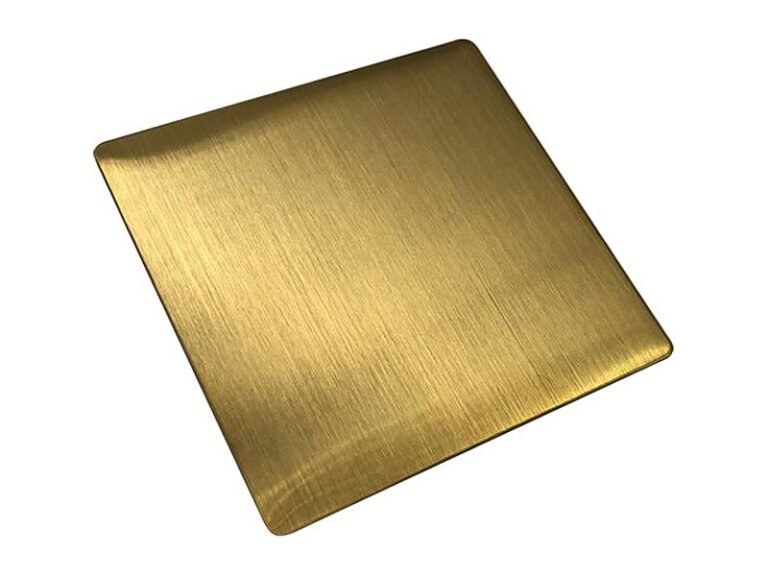
    PVD coloredA thin decorative coating applied by physical vapour deposition over a mirror, hairline, brushed or bead-blasted baseGold, rose gold, black, bronze and other colors. The base texture shows throughHotels, retail and interior design. See PVD colored sheets
    Anti-fingerprint (AF)A clear protective coating applied over brushed, hairline or PVD finishesThe same look, with fewer visible fingerprints and easier cleaningAppliances, lift panels, frequently touched surfaces. See anti-fingerprint sheets
    Stainless steel cold-rolled 2b sheets

    Cold-Rolled 2B Sheets
    0.3–6.0 mm, ASTM A240

    Stainless steel brushed & hairline sheets

    Brushed & Hairline Sheets
    No.4, HL, satin, 150#–400#

    Stainless steel mirror sheets

    Mirror Sheets
    6K, 8K and 10K mirror

    Stainless steel pvd colored sheets

    PVD Colored Sheets
    Gold, rose gold, black and more

    What do 6K, 8K and 10K mirror mean?

    “K” grades are a trade designation, widely used in the Asian market, for the level of mirror polish. 6K is a lower polish level, 8K is the common decorative mirror, and 10K is a higher-clarity mirror. They are not defined in ASTM or EN standards. When reflectivity is critical, agree a reference sample with the supplier.

    How to choose a finish

    • Hidden or structural parts: No.1 for plate, or 2B for sheet.
    • Deep drawing or heavy forming: 2D or 2B.
    • A bright look without polishing cost: BA.
    • Hiding fingerprints and light scratches: No.4 or HL, with an anti-fingerprint coating if surfaces are touched often.
    • Maximum reflectivity: 8K mirror on a BA base.
    • Colored interiors: PVD over mirror, hairline or bead blast.
    • Outdoors and coastal sites: choose a smoother finish with the grain running vertically so rain can rinse it, use grade 316, and plan regular washing.

    Fabrication tips for finished sheet

    • Keep the grain direction the same on adjacent panels, and order panels for one elevation from the same batch so the color and grain match.
    • Order laser film (rather than standard PVC film) if parts will be cut on a fiber laser. Remove protective film within the period the film supplier recommends, and keep filmed sheet out of direct sunlight.
    • Use stainless-only tools and abrasives to avoid iron contamination. Blend weld areas back to the surrounding finish, and clean or passivate them.

    How to specify a stainless steel sheet finish

    1. Grade, thickness and sheet size (or coil width)
    2. Finish name, plus grit for No.4 or HL, mirror level (6K/8K/10K) and base finish for mirror or PVD
    3. One side or two sides finished, and grain direction relative to length
    4. Protective film type (PVC or laser film) and thickness
    5. Edge condition, flatness and packing

    See our full range of stainless steel sheets and plates, or ask for samples of any finish.

    Why source from Yuhang Metal

    • Stainless steel supplier based in Foshan, Guangdong, since 1986. In 1988 we commissioned China’s first stainless steel high-frequency welded pipe mill.
    • Our own grinding, cut-to-length and slitting lines, including a 1,650 mm precision slitting line.
    • Finishes from 2B, BA and No.4/HL to 6K–10K mirror, PVD color, embossed, etched and anti-fingerprint.
    • PVC or laser film for fiber-laser cutting, and sheets cut to size.

    Frequently asked questions

    What is the difference between 2B and BA finish?

    Both are cold-rolled mill finishes. 2B is annealed and pickled, then skin passed, giving a smooth, slightly cloudy surface. BA is annealed in a protective atmosphere so no scale forms. The result is a brighter, more reflective and smoother surface that is often used as the base for mirror polishing.

    Is No.4 finish the same as hairline (HL)?

    No. Both are directional brushed finishes. No.4 has a relatively short grain made with about 120–150 grit abrasive. HL has long, continuous lines running the full length of the sheet.

    What does 8K mirror stainless steel mean?

    8K is a trade designation for a decorative mirror polish, broadly equivalent to the ASTM No.8 mirror finish. It is made by polishing with progressively finer abrasives and then buffing, usually on a BA or 2B base. 6K is a lower polish level and 10K a higher one.

    Can PVD color be applied to brushed or hairline stainless steel?

    Yes. PVD coatings can be applied over mirror, hairline, brushed and bead-blasted finishes. The coating is very thin, so the texture of the base finish stays visible under the color.

    Which stainless steel finish is best for outdoor use?

    Smoother finishes hold less dirt and salt, so they resist tea staining better. For outdoor and especially coastal use, combine a smooth finish with grade 316, run any grain vertically, and plan regular washing.

    Which stainless steel finish is best for food equipment?

    Smooth surfaces such as 2B, BA or a fine polish are easiest to clean, so they are widely used for food equipment. Hygienic standards and customers may also set a maximum surface roughness (Ra), which should be stated on the order.

    What is the difference between No.4 and No.8 finish?

    No.4 is a directional brushed finish with visible grain lines. No.8 is a non-directional mirror finish produced by polishing with progressively finer abrasives and then buffing.

    Does surface finish affect corrosion resistance?

    Yes. Smoother surfaces with fewer grooves hold less dirt and salt, so they resist staining and pitting better, especially outdoors. The grade is still the main factor: 316 performs better than 304 in chloride environments.

    References

    • ASTM A480/A480M – General requirements for flat-rolled stainless steel plate, sheet and strip
    • ASTM A240/A240M – Stainless steel plate, sheet and strip
    • EN 10088-2 – Stainless steels: sheet/plate and strip for general purposes
  • How to Choose a Stainless Steel Tube Coil for Tank Heating and Cooling

    How to Choose a Stainless Steel Tube Coil for Tank Heating and Cooling

    By Yuhang Metal Technical Team · Updated November 2026 · 9 min read

    Short answer: For most round, agitated tanks a helical coil is the right starting point. Choose a cage coil for large or strongly agitated tanks, serpentine or flat pancake coils for rectangular tanks and tank floors, and finned coils only for air or gas. Size the coil from the required heat-transfer area: A = π × OD × tube length.

    A tube coil moves heat between a medium flowing inside the tube (steam, hot water, thermal oil, glycol, chilled water or refrigerant) and the product around it. Most coils sit inside a tank or vessel, but the same bending work also produces stand-alone coaxial exchangers and finned coils for air. The shape you choose decides how much heat-transfer surface fits in the space, how well the product circulates around the tube, how easy the coil is to clean and drain, and how much it costs to make.

    This guide compares the common stainless steel coil types, shows how to estimate tube length and surface area, and lists the information a manufacturer needs to quote your coil correctly the first time.

    Key takeaways

    • A helical coil is the default choice for round, agitated tanks. A cage coil adds welded support bars for large tanks or strong agitation.
    • Serpentine, square and flat pancake coils suit rectangular tanks, baths and tank bottoms.
    • Corrugated coils add turbulence and flexibility per metre of tube. Finned coils are for air and gas, not for liquids that foul.
    • A coaxial (tube-in-tube) coil is a compact heat exchanger in its own right rather than an immersion coil.
    • Heat-transfer area is set by the thermal design. The manufacturer builds to that area, so give the required area, or the tube size and length.

    Stainless steel coil types at a glance

    Coil typeWhere it is usedStrengthsWatch-outs
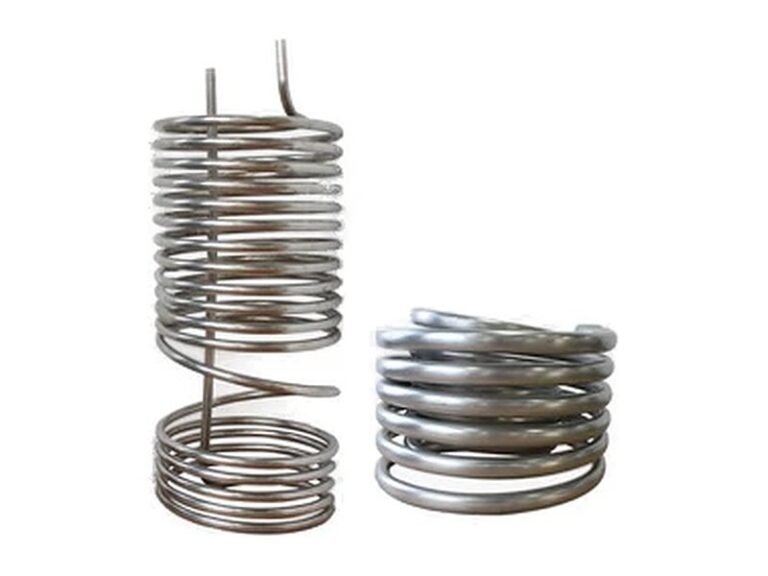
    Helical (spiral) coilRound tanks, reactors, fermenters, brewing vessels, water heatersSimple, efficient, fits around an agitator shaftTall coils need supports. Keep clearance to the agitator and the tank wall
    Compact helical coilSmall vessels, heaters, sample coolersMaximum tube length in a small volumeClose pitch limits circulation and cleaning between turns
    Conical coilCone-bottom tanks and hoppersFollows the cone so the last part of a batch is still heated or cooledHarder to support. Plan the drain direction
    Cage coil / double-layer cage coilLarge tanks, strongly agitated vesselsRigid assembly with the pitch fixed by welded support bars. A second layer adds surface in the same diameterHeavier. The inner layer of a double cage is harder to clean
    Serpentine coilRectangular tanks, plating and pickling baths, tank wallsFlat panel of straight runs joined by U-bendsEvery bend adds pressure drop
    Flat pancake coilTank bottoms, shallow trays and bathsHeats from the bottom with very little headroomSediment can settle on it. Check that it drains
    Square coilSquare and rectangular tanksUses the corners that a round coil wastesCorner bends are tighter than a round coil
    Corrugated coil / corrugated cage coilDuties that need more heat transfer per metre of tubeCorrugations disturb the boundary layer and add flexibility for thermal expansionHigher pressure drop. The inside is harder to clean
    Coaxial (tube-in-tube) coilHeat pumps, chillers, water or brine to refrigerantCompact counter-flow exchanger with two circuitsSpecify pressure and medium for both circuits
    Finned coil / framed coil bankAir and gas streams, ducts, dryersFins add surface on the gas sideNot for fouling liquids. Fin pitch must suit any dust load

    Coils from our workshop

    Stainless steel helical coils

    Helical Coils
    Spiral coils for round, agitated tanks

    Stainless steel cage coils

    Cage Coils
    Rigid coils with welded support bars

    Stainless steel serpentine coils

    Serpentine Coils
    Flat coils for rectangular tanks

    Stainless steel corrugated coils

    Corrugated Coils
    More surface per metre of tube

    Step 1: Define the thermal duty

    Coil surface is sized from the heat-transfer equation Q = U × A × ΔTlm. Here Q is the heat load, U the overall heat-transfer coefficient, A the tube surface area and ΔTlm the log-mean temperature difference. U depends heavily on agitation, product viscosity and fouling, so it should come from your process engineer or thermal designer. The coil manufacturer then builds to the required area. Collect these numbers before you ask for a quote:

    • Heat load in kW, or the required heat-up or cool-down time for a given batch
    • The product in the tank, its volume and, if relevant, its viscosity and solids content
    • The medium inside the tube, with its inlet and outlet temperatures and flow rate
    • Design pressure and design temperature for the tube side

    Step 2: Estimate tube length and surface area

    The outside surface of a coil is simply A = π × OD × L, where L is the developed tube length. For a helical coil, the length is approximately L ≈ N × √((π × Dc)² + p²). N is the number of turns, Dc the coil centreline diameter and p the pitch.

    Worked example: 25.4 mm OD tube, coil centreline diameter 800 mm, pitch 50 mm, 20 turns:

    • Length per turn = √((π × 800)² + 50²) ≈ 2,514 mm
    • Developed length L ≈ 20 × 2.514 m ≈ 50.3 m
    • Outside area A ≈ π × 0.0254 m × 50.3 m ≈ 4.0 m²

    If you need more area than fits, the usual options are more turns, a second layer (a double-layer cage coil), a smaller pitch, or a corrugated tube.

    Step 3: Match the coil shape to the tank

    • Round tank with an agitator: helical coil, or a cage coil when the tank is large or the agitation is strong.
    • Rectangular tank or process bath: serpentine or square coil along the walls. Use a flat pancake coil for the floor.
    • Cone-bottom tank: a conical coil to reach the product in the cone.
    • Little space, high duty: compact helical, double-layer cage or corrugated coil.
    • Heating or cooling air: finned coil or framed coil bank.

    Leave room between the coil and the tank wall, and between the coil and the agitator blades, so the product can circulate. Also check how the coil goes in and comes out. If it cannot pass through the manway or lid opening, it must be made in sections with flanged joints.

    Step 4: Choose tube size, pitch, grade and connections

    • Tube OD × wall. A larger OD lowers pressure drop and stiffens the coil. A thinner wall transfers heat better and costs less, but it must still carry the design pressure after bending. Bending thins the outer wall and makes the tube slightly oval, and the effect grows as the coil diameter gets smaller relative to the tube OD.
    • Pitch. A spaced pitch lets product flow between turns and allows cleaning. A close-wound coil fits the most tube into the least height.
    • Steam service. Arrange the coil so that condensate drains to the outlet, normally with steam in at the top and condensate out at the bottom, and no low pockets in between.
    • Grade. 304/304L suits most water and food duties. 316/316L is the usual step up where chlorides or mild acids are present. Duplex 2205 is chosen where chloride stress corrosion cracking is a risk, for example in warm chloride-bearing water. Confirm the grade against corrosion data for your product.
    • Surface. Pickled and passivated is standard. Bright annealed or electropolished tube suits hygienic and pharmaceutical duty.
    • Connections and supports. Choose plain ends for welding, or threaded, flanged, tri-clamp or compression fittings. Add brackets, clips or support bars as the tank requires.

    Step 5: Testing and documents

    • Pressure test every coil. Use a hydrostatic or pneumatic test at a pressure taken from the applicable code. For example, ASME B31.3 uses 1.5 × design pressure for a hydrostatic test. Put the test pressure and hold time on the drawing.
    • Use low-chloride water for hydrostatic tests of austenitic stainless steel, and drain and dry the coil afterwards.
    • Vacuum or refrigerant service may also need a helium leak test. Specify it on the enquiry.
    • Documents: EN 10204 3.1 material certificates, a dimensional report, and approval drawings before production.

    What to send for a coil quotation

    1. Tank drawing or inside diameter and height, agitator position, and manway or lid opening size
    2. Coil type and a sketch: coil inside or outside diameter, height or number of turns, and pitch
    3. Tube OD × wall thickness and grade
    4. Medium, design pressure and design temperature
    5. Inlet and outlet positions and connection type
    6. Supports or brackets, surface finish, testing and certificates
    7. Quantity and delivery destination

    Browse all stainless steel tube coils, or send your drawing through our contact page for a quotation.

    Why source from Yuhang Metal

    • Stainless steel supplier based in Foshan, Guangdong, since 1986. In 1988 we commissioned China’s first stainless steel high-frequency welded pipe mill.
    • Tube coils made to your drawing in 304/304L, 316/316L, 321 and 2205, from 6–60 mm tube OD, with coil inside diameters from 30 mm (helical) up to 2,500 mm (cage).
    • Every coil is pressure tested, hydrostatically or pneumatically, and approval drawings are issued before production.
    • EN 10204 3.1 material certificates.

    Frequently asked questions

    What is the difference between a helical coil and a cage coil?

    A helical coil is a free-standing spiral of tube. A cage coil is a helical, or multi-layer, coil fixed to welded vertical support bars. The bars set the pitch and make the assembly rigid enough for large tanks and strong agitation.

    Which stainless steel grade is best for a tank heating coil?

    304/304L covers most water and food duties. 316/316L is preferred where chlorides or mild acids are present. Duplex 2205 is used where chloride stress corrosion cracking is a risk. Always confirm the choice against corrosion data for your product and temperature.

    How do I calculate the heat-transfer area of a coil?

    Outside area A = π × OD × L, where L is the developed tube length. For a helical coil, L ≈ N × √((π × Dc)² + p²), with N turns, centreline diameter Dc and pitch p. For example, 20 turns of 25.4 mm tube at 800 mm centreline diameter and 50 mm pitch gives about 50 m of tube and 4.0 m² of surface.

    Can a tube coil be made to my own drawing?

    Yes. Send a dimensioned sketch or CAD drawing with tube size, grade, coil dimensions, connections and test requirements. Approval drawings are issued before production starts.

    Should I use an internal coil or a jacket to heat a tank?

    A jacket heats through the vessel wall and leaves the inside free of obstructions, which suits viscous products and easy cleaning. An internal coil usually gives a higher heat-transfer coefficient and more surface for the same vessel, but it takes space inside the tank and must itself be cleaned.

    How should a steam coil be drained?

    Arrange the coil so condensate falls continuously towards the outlet, normally with steam in at the top and condensate out at the bottom, and fit a suitable steam trap. If the outlet pipe has to rise out of the tank, the drainage arrangement must stop the coil from waterlogging.

    What tube sizes can be made into coils?

    Our helical coils use tube from 6 to 60 mm OD with 0.5–3.0 mm wall and coil inside diameters from 30 to 2,000 mm. Cage coils use 12–60 mm tube with coil inside diameters from 200 to 2,500 mm.

    References

    • ASME B31.3 – Process Piping (pressure test requirements)
    • EN 10204 – Metallic products: types of inspection documents
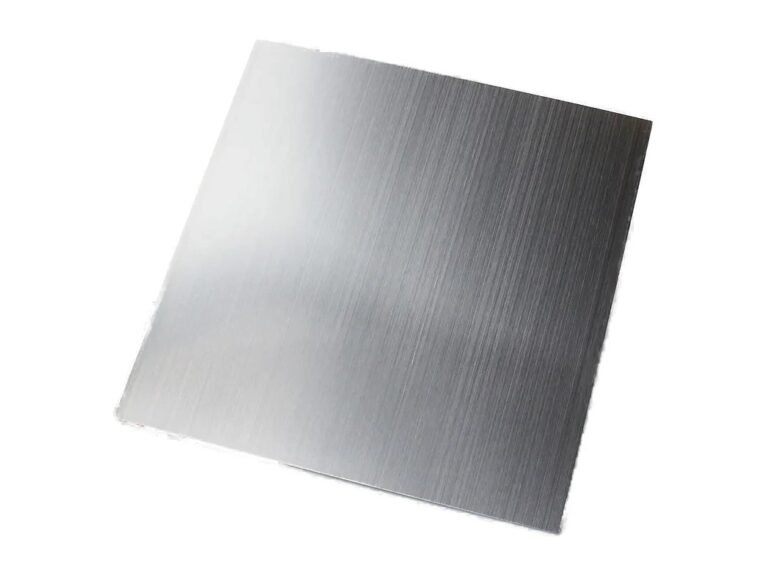
    • ASTM A269/A269M – Stainless steel tubing for general service