
By Yuhang Metal Technical Team · November 2026 · 6 min read
Quick answer: Many bad experiences with Chinese stainless steel come from deals where the price was too low for the specification, or where nobody checked the supplier. Some suppliers cut wall thickness or switch to cheaper grades to hit a price, and a few are not real suppliers at all. A low price is a warning sign, but a high price is not a guarantee either. What protects you is a supplier who takes responsibility for every production step, and a buyer who verifies before paying.
Key takeaways
- Problems often come from orders priced below the real cost of the specification, or from suppliers who were never verified.
- Common shortcuts: thinner walls, cheaper grades sold as 304, skipped annealing or testing, and certificates that can’t be traced.
- A 2.0 mm wall supplied on a 2.5 mm nominal-wall order is out of spec under ASTM A312 (minimum about 2.19 mm) and carries about 20% less steel.
- A low price is a warning sign, but a high price is not a guarantee. Responsibility at every production step is what matters.
- Quotations depend on grade, processing, testing, quantity, delivery terms and raw material prices.
Contents
- Why the complaints happen
- What “just inside” and “out of spec” look like
- 2.5 mm or 2.0 mm? Check the wall yourself
- Verify the supplier, not just the price
- Low price does not mean good quality, and high price does not guarantee it
- Why responsible Chinese manufacturers protect their name
- What drives a stainless steel quotation
- How to make sure you receive what you ordered
- Frequently asked questions
- References
Why the complaints happen
We hear it from buyers in several markets: “The stainless steel we got from China wasn’t what we ordered.” We understand the frustration, and we would rather explain it honestly than pretend it never happens.
China has thousands of stainless steel suppliers, and their quotes for the same item can differ a lot. When a buyer pushes the price below what the specification really costs, the supplier still has to make money somewhere. Usually it comes out of one of these:
- Wall thickness: made right at the bottom of the tolerance, or below it.
- Grade: a cheaper, lower-nickel steel supplied in place of 304.
- Process steps: annealing, pickling or testing skipped.
- Paperwork: certificates that can’t be traced to the material actually delivered.
What “just inside” and “out of spec” look like
Tolerances in the standards exist for good reasons, but they are also where cost-cutting hides.
| Item | Standard requirement | What to watch for |
|---|---|---|
| Wall thickness, ASTM A312 pipe (nominal wall ordered) | Wall may be up to 12.5% under nominal | 2.0 mm nominal → minimum 1.75 mm. 2.5 mm nominal → minimum about 2.19 mm. 3.0 mm nominal → minimum about 2.63 mm. |
| Grade 304 (ASTM A240) | Ni 8.0–10.5%, Cr 17.5–19.5% | — |
| Grade 201 (ASTM A240) | Ni 3.5–5.5%, Cr 16.0–18.0%, Mn 5.5–7.5% | Looks the same as 304 but has much lower corrosion resistance |
| Low-cost “200-series” grades | Not covered by ASTM | Some contain only about 1% Ni and are sometimes sold or marked as 304 |
2.5 mm or 2.0 mm? Check the wall yourself
One of the most common substitutions we see is a 2.0 mm wall delivered against a 2.5 mm order. On the outside the tube looks identical. If the order specifies a 2.5 mm nominal wall and the 12.5% under-tolerance applies, the minimum is about 2.19 mm, so 2.0 mm is out of spec. If the order specifies a 2.5 mm minimum wall, no under-tolerance applies at all.
For a 60.3 mm OD tube with a uniform wall, the theoretical weight is about 3.60 kg/m at 2.5 mm and about 2.90 kg/m at 2.0 mm, around 19% less steel.
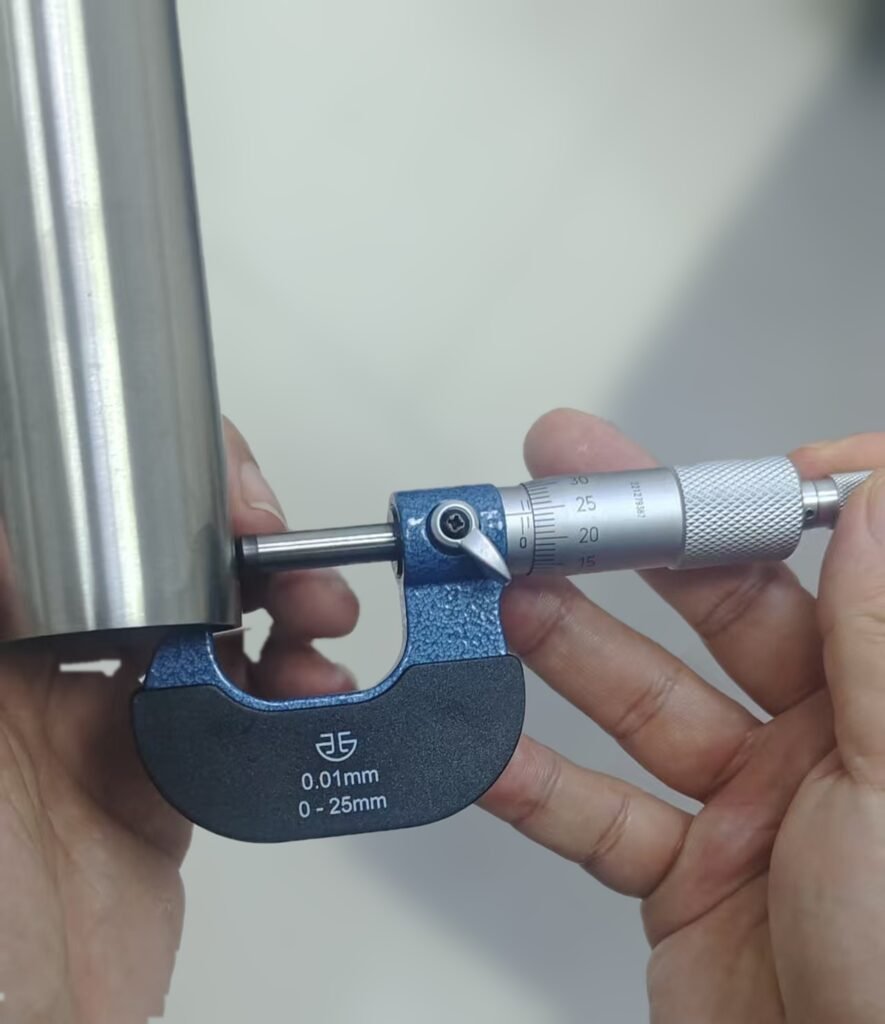
The check takes a few seconds. Measure the wall at the tube end with a micrometer that reads to 0.01 mm, and take readings at several points around the circumference. This is a sampling check: it does not prove that the whole length, or the whole lot, conforms.
Verify the supplier, not just the price
Some losses have nothing to do with metallurgy. The material is never shipped, or what arrives is not what was paid for. Basic checks reduce that risk:
- Verify the business licence and confirm the company actually manufactures or stocks the product.
- Visit the factory, or ask for a live video tour.
- Use third-party pre-shipment inspection and loading supervision.
- Use payment terms that release the balance only against shipping documents or an inspection report.
Remember that a bill of lading or packing list confirms what was shipped. It is not evidence of quality.
Low price does not mean good quality, and high price does not guarantee it
Some suppliers charge more without doing more. The real difference is whether the factory takes responsibility at each stage: raw material selection, forming and welding, heat treatment and pickling, testing, and final inspection before packing. A factory that controls these steps, and can show you the records, can stand behind its product at any price.
Why responsible Chinese manufacturers protect their name
More Chinese manufacturers, us included, are building their own brands abroad instead of competing on price alone. An export brand lives on repeat customers and long-term partners. Trading that reputation for one cheap order makes no sense.
What drives a stainless steel quotation
Quotations for apparently identical material can differ for legitimate reasons:
- Grade, for example 304L, 316L or duplex 2205, and whether dual certification is required.
- Processing: seamless or welded, annealing, pickling, polishing, end finish.
- Size and wall, and whether the wall is nominal or minimum.
- Testing and certificates: extra NDE, PMI, intergranular corrosion tests, EN 10204 3.2.
- Quantity, lengths, packing and delivery terms.
- Raw material prices: stainless steel costs follow international prices of nickel, chromium and molybdenum, so quotations are normally valid for a limited period.
When comparing quotations, make sure they are based on the same specification.
How to make sure you receive what you ordered
- Specify the standard and grade in full, for example ASTM A312 TP316L (UNS S31603), with the edition year, and state whether the wall is nominal or minimum.
- Ask for EN 10204 3.1 certificates, and check that the grade, size and heat numbers match the marking on the material.
- Measure wall thickness and outside diameter on arrival against the tolerances on your order.
- Check the grade with PMI. A handheld XRF analyser separates 200-series, 304 and 316, but it cannot measure carbon. If you need to confirm an L grade such as 316L, agree a carbon-capable method such as OES.
- If your project needs EN 10204 3.2, agree it before ordering, including who will witness the tests. A general third-party inspection report is not a 3.2 certificate.
- Compare quotes on an identical specification. If one is far below the rest, ask exactly what is different.
Browse our stainless steel pipes and tubes, or request a quote with your grade, size, quantity and inspection requirements.
Frequently asked questions
Is stainless steel from China lower quality?
Not by default. Quality depends on the factory and the specification, not the country.
Why are some Chinese stainless steel prices so low?
Often because something changed: a thinner wall, a cheaper grade, or skipped processing or testing. Ask the supplier to quote against an identical, fully written specification.
What is the minimum wall for 2.5 mm ASTM A312 pipe?
If 2.5 mm is the nominal wall and the 12.5% under-tolerance applies, the minimum is about 2.19 mm. If 2.5 mm is specified as the minimum wall, the wall must not be below 2.5 mm.
Can a handheld XRF analyser confirm 316L?
No. XRF can tell 316 from 304, but it cannot measure carbon, so it cannot confirm the low-carbon L grade on its own.
Why do stainless steel quotations change?
They depend on grade, processing, testing, quantity and delivery terms, and on raw material prices such as nickel, chromium and molybdenum.
References
- ASTM A312/A312M – Seamless, welded and heavily cold worked austenitic stainless steel pipes
- ASTM A240/A240M – Stainless steel plate, sheet and strip
- EN 10204 – Metallic products: types of inspection documents