
By Yuhang Metal Technical Team · Updated November 2026 · 7 min read
Short answer: 2B is the standard cold-rolled finish for fabrication and BA is a brighter mill finish. No.4 and HL are brushed decorative finishes, 8K is a mirror polish, and PVD adds color over a base finish. Choose by appearance, cleanability and outdoor exposure, and state the finish, grit and film type on the order.
The finish of a stainless steel sheet affects much more than its looks. It changes how easily the surface cleans, how well it resists staining outdoors, how it behaves in forming, and what it costs. Finish names come from several systems. ASTM A480 uses No.1, No.2D, No.2B, BA, No.3, No.4 and No.8. EN 10088-2 uses codes such as 1D, 2B and 2R. Trade terms such as HL and 8K are also widely used. This guide puts them side by side.
Key takeaways
- Mill finishes (No.1, 2D, 2B, BA) are produced on the rolling and annealing line. Polished and decorative finishes (No.3, No.4, HL, 8K, bead blast, PVD) are added afterwards.
- 2B is the most common cold-rolled finish and the usual base for fabrication. BA is brighter and smoother.
- No.4 and HL are both directional brushed finishes. No.4 has a short grain. HL has long, continuous lines.
- 8K (No.8) mirror is a non-directional, highly reflective polish. PVD adds color on top of a base finish without hiding its texture.
- Smoother finishes hold less dirt and resist tea staining better outdoors. For coastal sites, combine a smooth finish with grade 316.
Contents
Mill finishes
| Finish (ASTM A480) | EN 10088-2 | How it is made | Appearance | Typical uses |
|---|---|---|---|---|
| No.1 | 1D | Hot rolled, annealed and pickled | Dull, rough, non-reflective | Thick plate for tanks, structural and industrial equipment where looks do not matter. See hot-rolled plates |
| No.2D | 2D | Cold rolled, annealed and pickled | Uniform matt grey | Deep-drawn parts, and parts that will be painted or polished later |
| No.2B | 2B | Cold rolled, annealed and pickled, then given a light skin pass on polished rolls | Smooth, moderately reflective, slightly cloudy | The general-purpose finish: kitchen and food equipment, chemical tanks, and the base for polishing. See cold-rolled 2B sheets |
| BA (bright annealed) | 2R | Cold rolled, then annealed in a protective atmosphere so no scale forms, usually followed by a light skin pass | Bright and highly reflective | Appliances, trim, reflectors, and the base for mirror polishing. See BA sheets |
From roughest to smoothest, the mill finishes run No.1 → 2D → 2B → BA. Published roughness (Ra) figures for each finish vary between sources, mills and thicknesses, and thinner cold-rolled gauges are generally smoother. If roughness matters for hygiene, adhesion or appearance, state an Ra limit and the measurement method on the order rather than relying on the finish name alone.
Polished and decorative finishes
| Finish | How it is made | Appearance | Typical uses |
|---|---|---|---|
| No.3 | Intermediate polish with a coarser abrasive, finishing at about 100–120 grit | Visible, fairly coarse directional lines | Industrial equipment, or a base for further polishing |
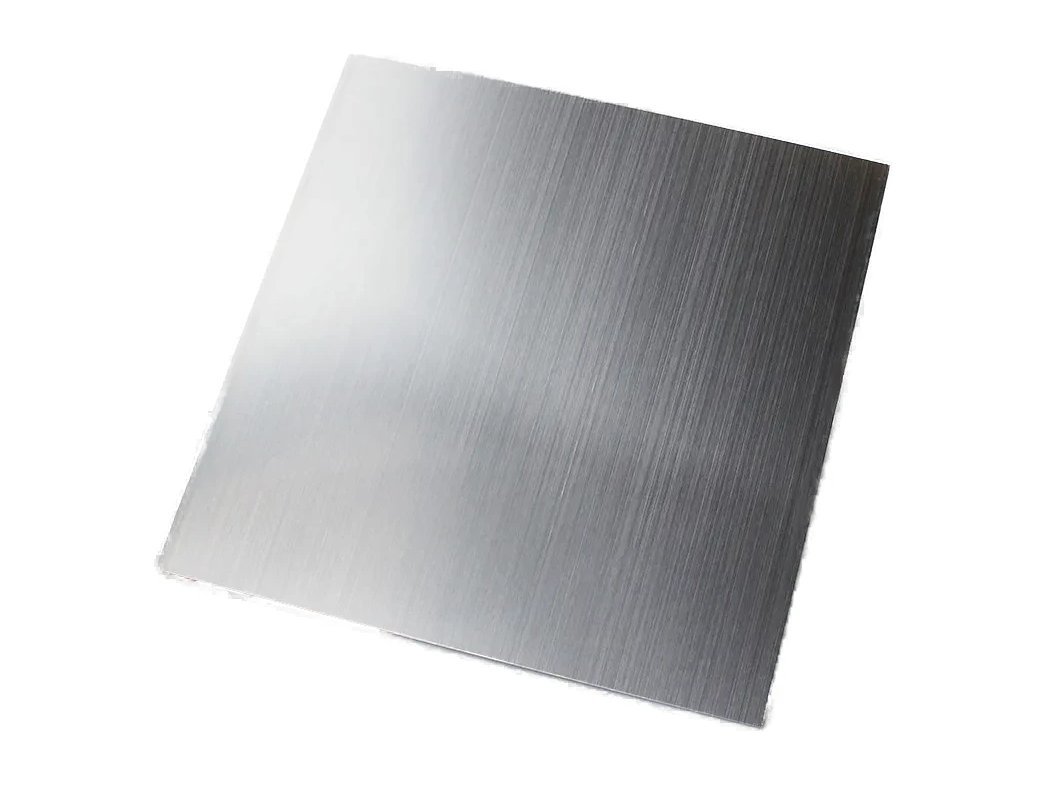
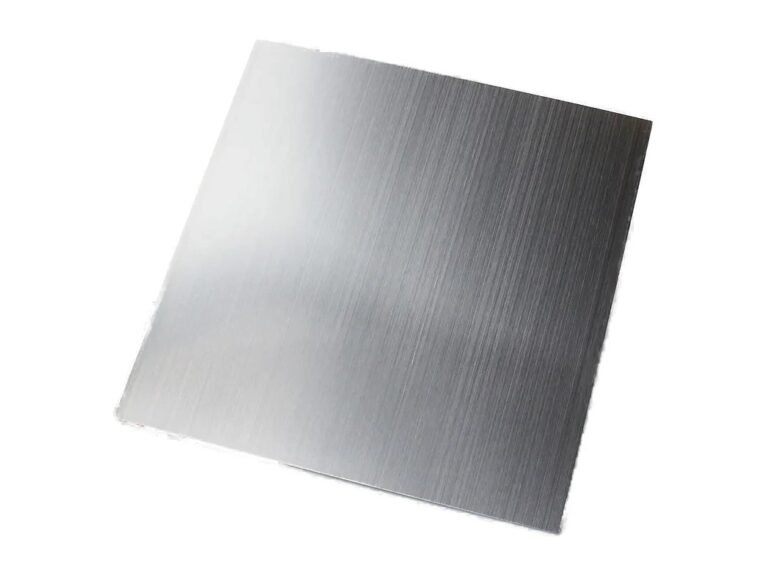
| No.4 (brushed / satin) | General-purpose polish, typically finished at about 120–150 grit. Finer grits give a softer satin | Short directional grain with low glare | Kitchen equipment, appliances, lift interiors. See brushed and hairline sheets |
| HL (hairline) | Continuous abrasive lines run along the full length of the sheet | Long, straight, uninterrupted grain | Lifts, architectural cladding, signage, furniture |
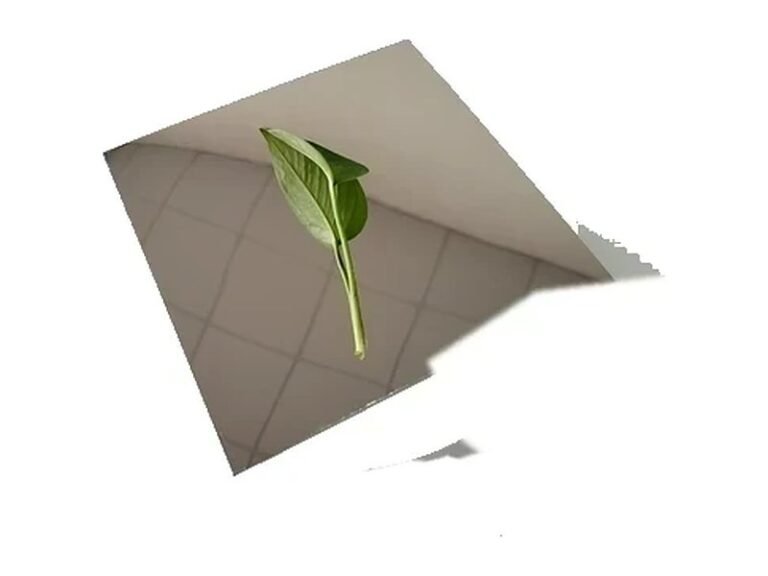
| No.8 / 8K mirror | Polished with progressively finer abrasives, then buffed. Usually done on a BA or 2B base | Mirror-like and non-directional | Decorative panels, signage, reflectors, ceilings. See mirror sheets |
| Bead blasted | Blasted with glass or ceramic beads | Even, non-directional matt with low glare | Architecture, furniture, interiors. See bead-blasted sheets |
| Embossed, etched, water ripple | Rolled-in patterns, chemical etching, or formed ripple textures | Textured or patterned. Embossing also hides scratches | Lift cabins, wall panels, ceilings. See embossed, etched and water ripple sheets |
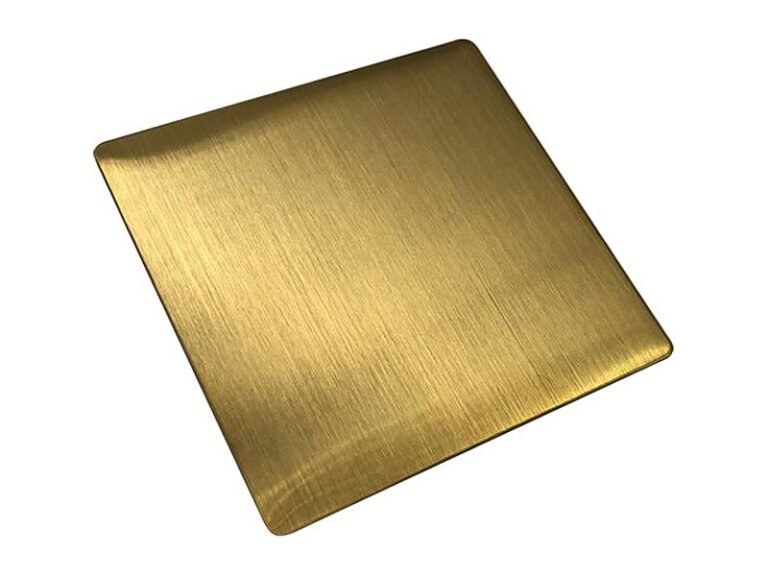
| PVD colored | A thin decorative coating applied by physical vapour deposition over a mirror, hairline, brushed or bead-blasted base | Gold, rose gold, black, bronze and other colors. The base texture shows through | Hotels, retail and interior design. See PVD colored sheets |
| Anti-fingerprint (AF) | A clear protective coating applied over brushed, hairline or PVD finishes | The same look, with fewer visible fingerprints and easier cleaning | Appliances, lift panels, frequently touched surfaces. See anti-fingerprint sheets |
Related products

Cold-Rolled 2B Sheets
0.3–6.0 mm, ASTM A240
Brushed & Hairline Sheets
No.4, HL, satin, 150#–400#
Mirror Sheets
6K, 8K and 10K mirror
PVD Colored Sheets
Gold, rose gold, black and more
What do 6K, 8K and 10K mirror mean?
“K” grades are a trade designation, widely used in the Asian market, for the level of mirror polish. 6K is a lower polish level, 8K is the common decorative mirror, and 10K is a higher-clarity mirror. They are not defined in ASTM or EN standards. When reflectivity is critical, agree a reference sample with the supplier.
How to choose a finish
- Hidden or structural parts: No.1 for plate, or 2B for sheet.
- Deep drawing or heavy forming: 2D or 2B.
- A bright look without polishing cost: BA.
- Hiding fingerprints and light scratches: No.4 or HL, with an anti-fingerprint coating if surfaces are touched often.
- Maximum reflectivity: 8K mirror on a BA base.
- Colored interiors: PVD over mirror, hairline or bead blast.
- Outdoors and coastal sites: choose a smoother finish with the grain running vertically so rain can rinse it, use grade 316, and plan regular washing.
Fabrication tips for finished sheet
- Keep the grain direction the same on adjacent panels, and order panels for one elevation from the same batch so the color and grain match.
- Order laser film (rather than standard PVC film) if parts will be cut on a fiber laser. Remove protective film within the period the film supplier recommends, and keep filmed sheet out of direct sunlight.
- Use stainless-only tools and abrasives to avoid iron contamination. Blend weld areas back to the surrounding finish, and clean or passivate them.
How to specify a stainless steel sheet finish
- Grade, thickness and sheet size (or coil width)
- Finish name, plus grit for No.4 or HL, mirror level (6K/8K/10K) and base finish for mirror or PVD
- One side or two sides finished, and grain direction relative to length
- Protective film type (PVC or laser film) and thickness
- Edge condition, flatness and packing
See our full range of stainless steel sheets and plates, or ask for samples of any finish.
Why source from Yuhang Metal
- Stainless steel supplier based in Foshan, Guangdong, since 1986. In 1988 we commissioned China’s first stainless steel high-frequency welded pipe mill.
- Our own grinding, cut-to-length and slitting lines, including a 1,650 mm precision slitting line.
- Finishes from 2B, BA and No.4/HL to 6K–10K mirror, PVD color, embossed, etched and anti-fingerprint.
- PVC or laser film for fiber-laser cutting, and sheets cut to size.
Frequently asked questions
What is the difference between 2B and BA finish?
Both are cold-rolled mill finishes. 2B is annealed and pickled, then skin passed, giving a smooth, slightly cloudy surface. BA is annealed in a protective atmosphere so no scale forms. The result is a brighter, more reflective and smoother surface that is often used as the base for mirror polishing.
Is No.4 finish the same as hairline (HL)?
No. Both are directional brushed finishes. No.4 has a relatively short grain made with about 120–150 grit abrasive. HL has long, continuous lines running the full length of the sheet.
What does 8K mirror stainless steel mean?
8K is a trade designation for a decorative mirror polish, broadly equivalent to the ASTM No.8 mirror finish. It is made by polishing with progressively finer abrasives and then buffing, usually on a BA or 2B base. 6K is a lower polish level and 10K a higher one.
Can PVD color be applied to brushed or hairline stainless steel?
Yes. PVD coatings can be applied over mirror, hairline, brushed and bead-blasted finishes. The coating is very thin, so the texture of the base finish stays visible under the color.
Which stainless steel finish is best for outdoor use?
Smoother finishes hold less dirt and salt, so they resist tea staining better. For outdoor and especially coastal use, combine a smooth finish with grade 316, run any grain vertically, and plan regular washing.
Which stainless steel finish is best for food equipment?
Smooth surfaces such as 2B, BA or a fine polish are easiest to clean, so they are widely used for food equipment. Hygienic standards and customers may also set a maximum surface roughness (Ra), which should be stated on the order.
What is the difference between No.4 and No.8 finish?
No.4 is a directional brushed finish with visible grain lines. No.8 is a non-directional mirror finish produced by polishing with progressively finer abrasives and then buffing.
Does surface finish affect corrosion resistance?
Yes. Smoother surfaces with fewer grooves hold less dirt and salt, so they resist staining and pitting better, especially outdoors. The grade is still the main factor: 316 performs better than 304 in chloride environments.
References
- ASTM A480/A480M – General requirements for flat-rolled stainless steel plate, sheet and strip
- ASTM A240/A240M – Stainless steel plate, sheet and strip
- EN 10088-2 – Stainless steels: sheet/plate and strip for general purposes